

AEF Crop Intelligence – Agricultural digital twin, recommendations and pre-planting assessment

Client: Scale AG – internal project

Scale AG · Agricultural decision support · Scientific alpha

AEF Crop Intelligence turns agricultural data into actionable decisions

One application to define a field, simulate its future, optimize irrigation, fertilization and disease interventions, test scenarios and generate readable PDF dossiers. This page stays compact: the screenshots are organized into two carousels.

🛰️ Satellite🌱 Growth🦠 Disease💧 Irrigation💰 Economics📄 PDF

🌍 Three field-ready modes

Single field, agricultural cooperative and pre-planting assessment. The selected mode truly changes the workflow and assumptions.

🧭 Cautious diagnosis

AEF makes assumptions, uncertainty, field validation needs and adaptive surveillance explicit.

📊 Agronomic and economic decisions

The app compares baseline, agronomic optimum, economic optimum and what-if scenarios.

Visual walkthrough of the application

Browse the main AEF Crop Intelligence screens, from initial access to recommendations, scenarios, adaptive surveillance, cooperative mode and pre-planting assessment.
AEF Crop Intelligence overview
1

AEF Crop Intelligence overview

The visual entry point to the platform: an agricultural digital twin connecting map, crop, soil, disease, economics, scenarios and reports.

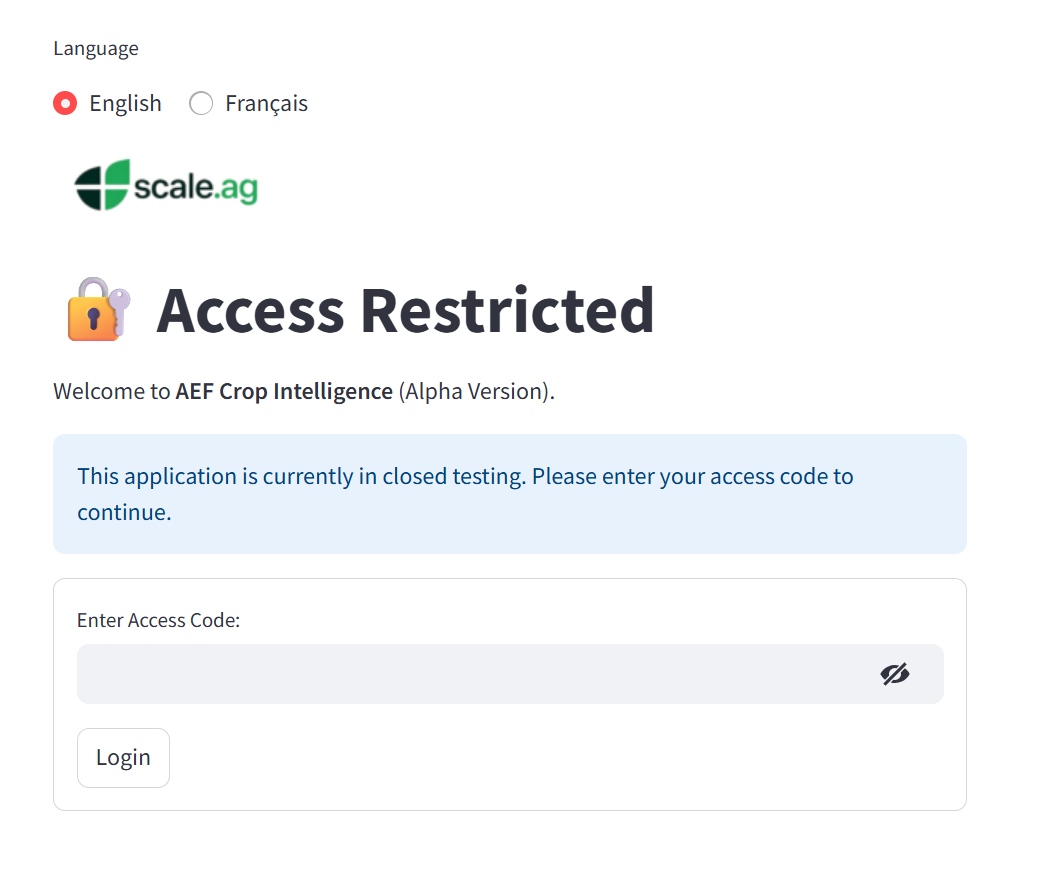
Access and language
2

Access and language

The first interaction sets the frame: controlled access, French/English switch, then a consistent interface in the selected language.

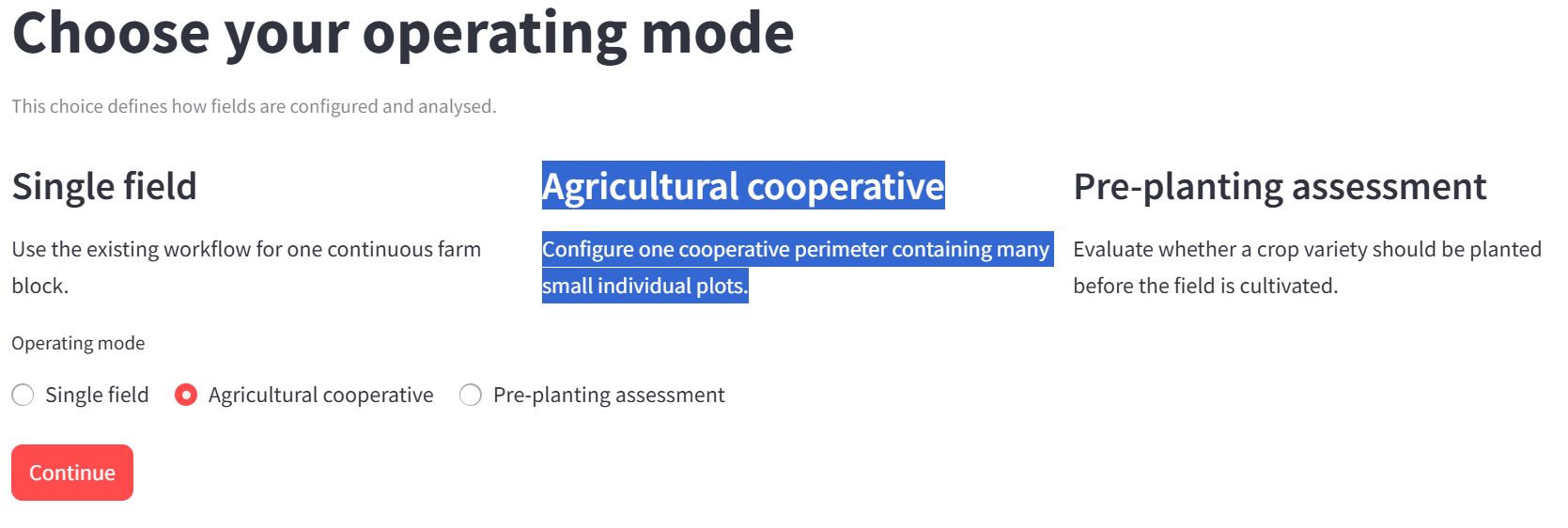
Choose the right mode
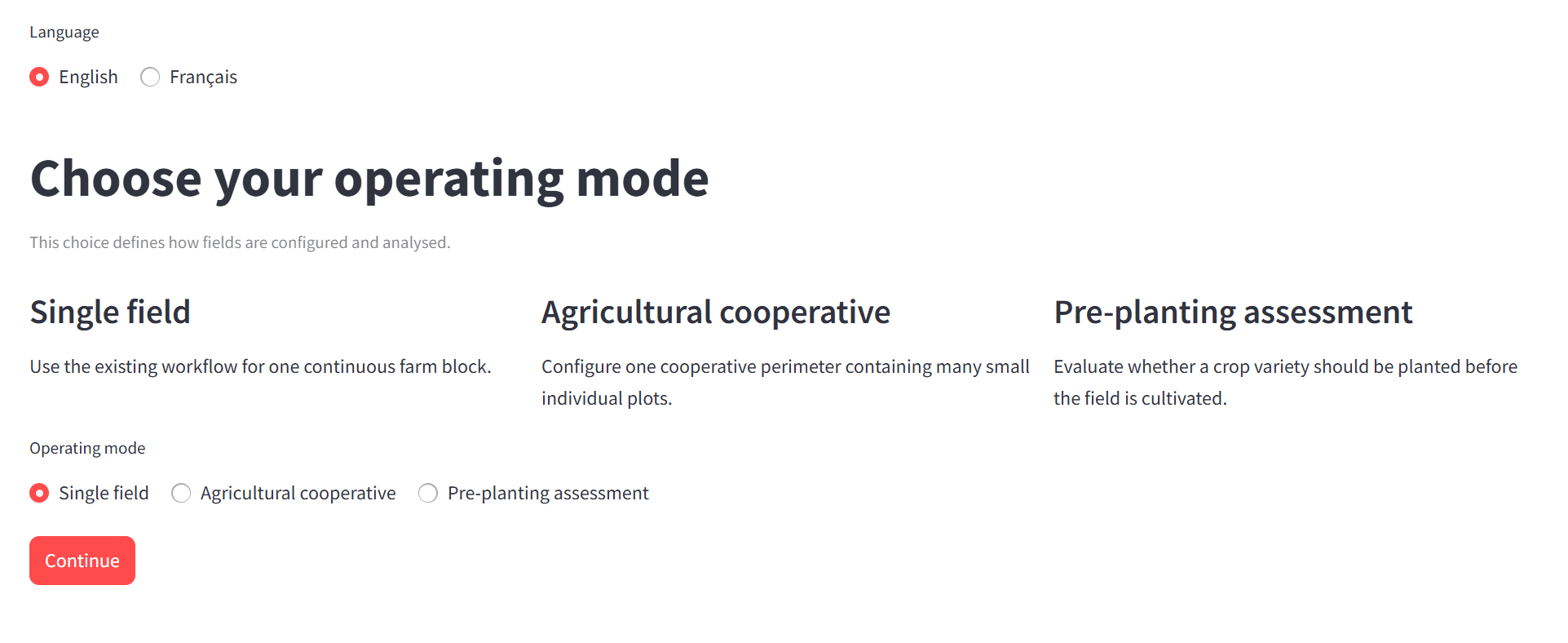
3

Choose the right mode

AEF offers three modes: single field, agricultural cooperative and pre-planting assessment. A continuous plantation, a smallholder mosaic and an investment decision do not need the same workflow.
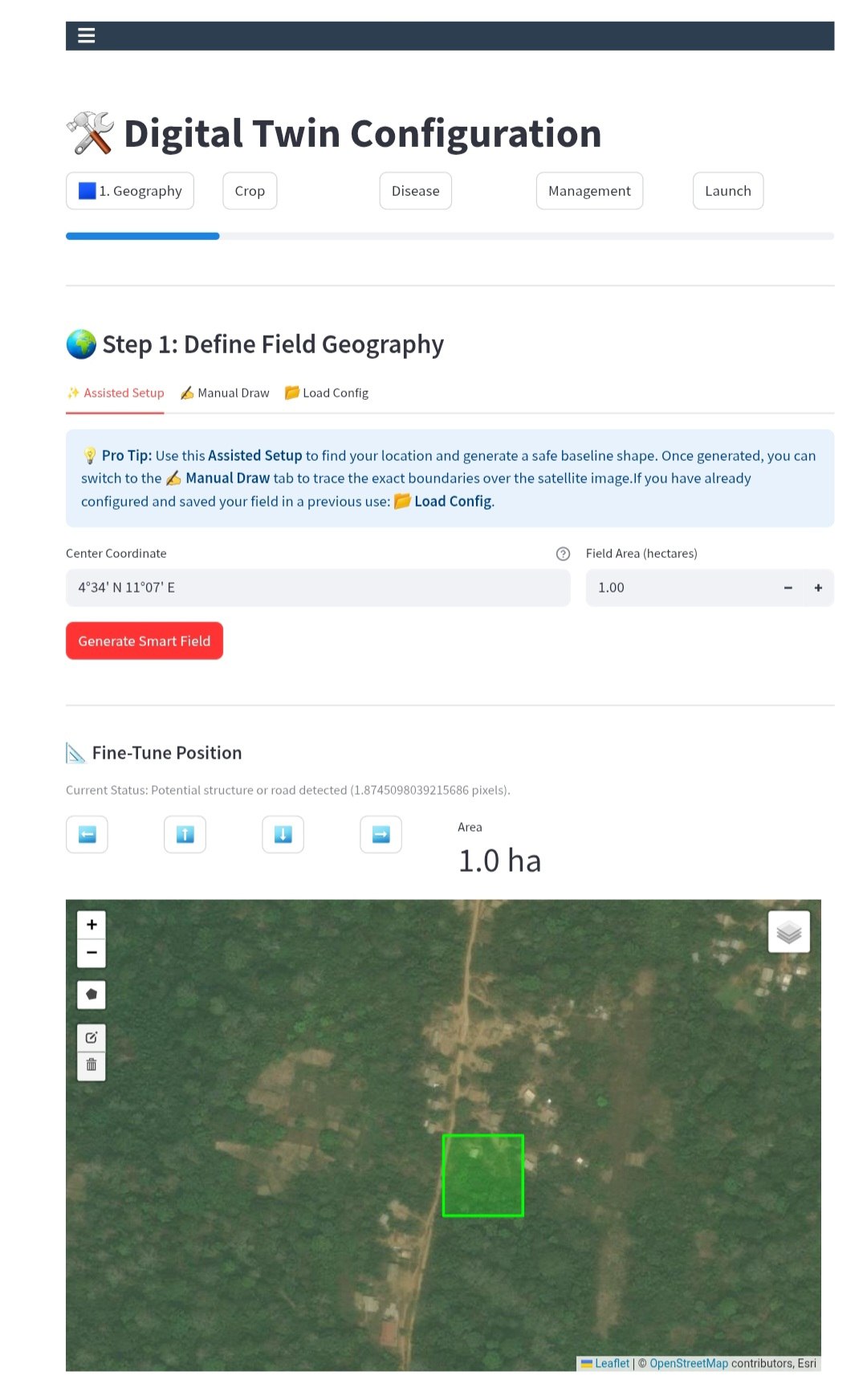
Single field: map and area
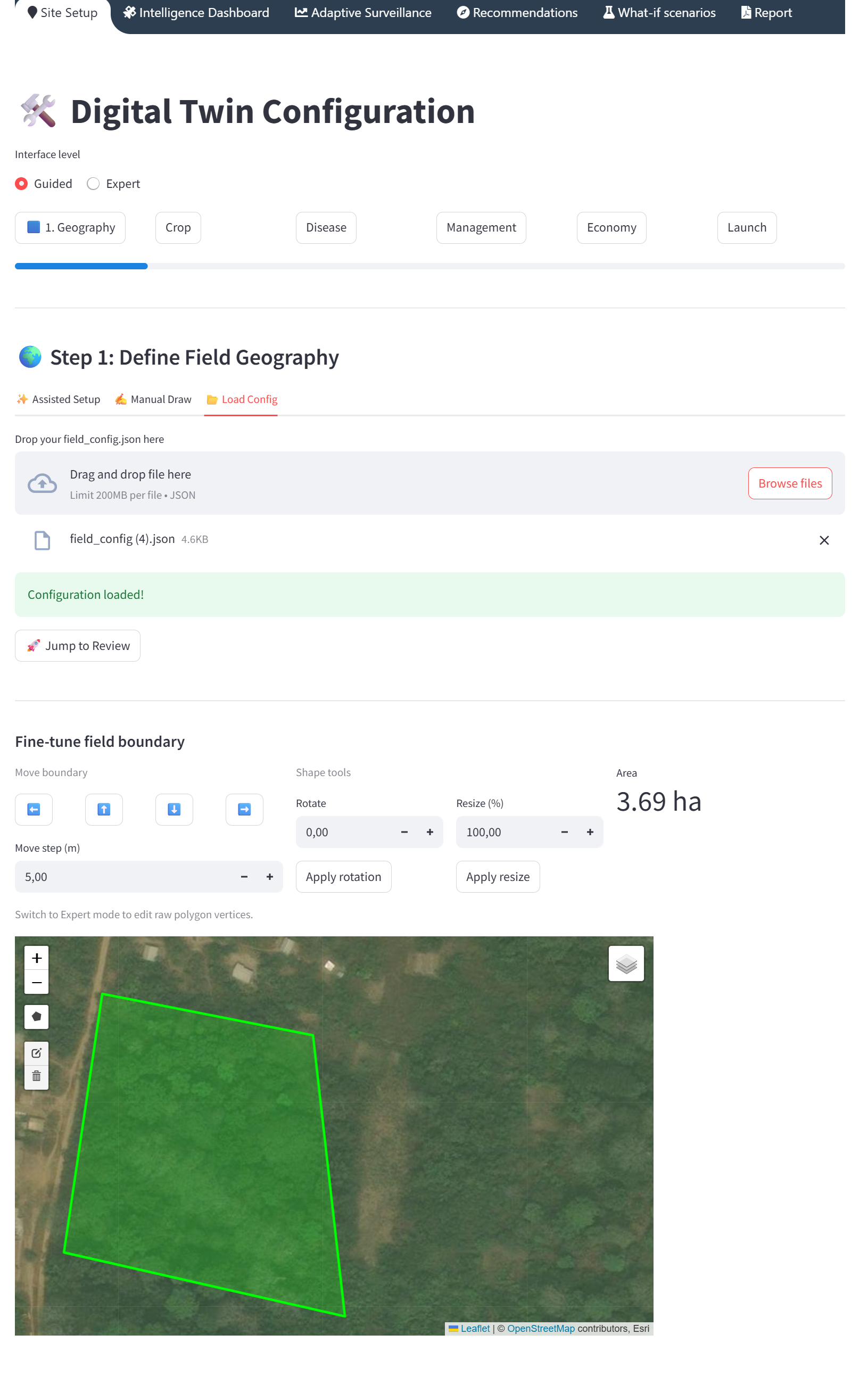
4

Single field: map and area

Single-field mode starts with a zoomable satellite map, field center and area check. The field can be drawn, imported or adjusted.

Smart editable boundary
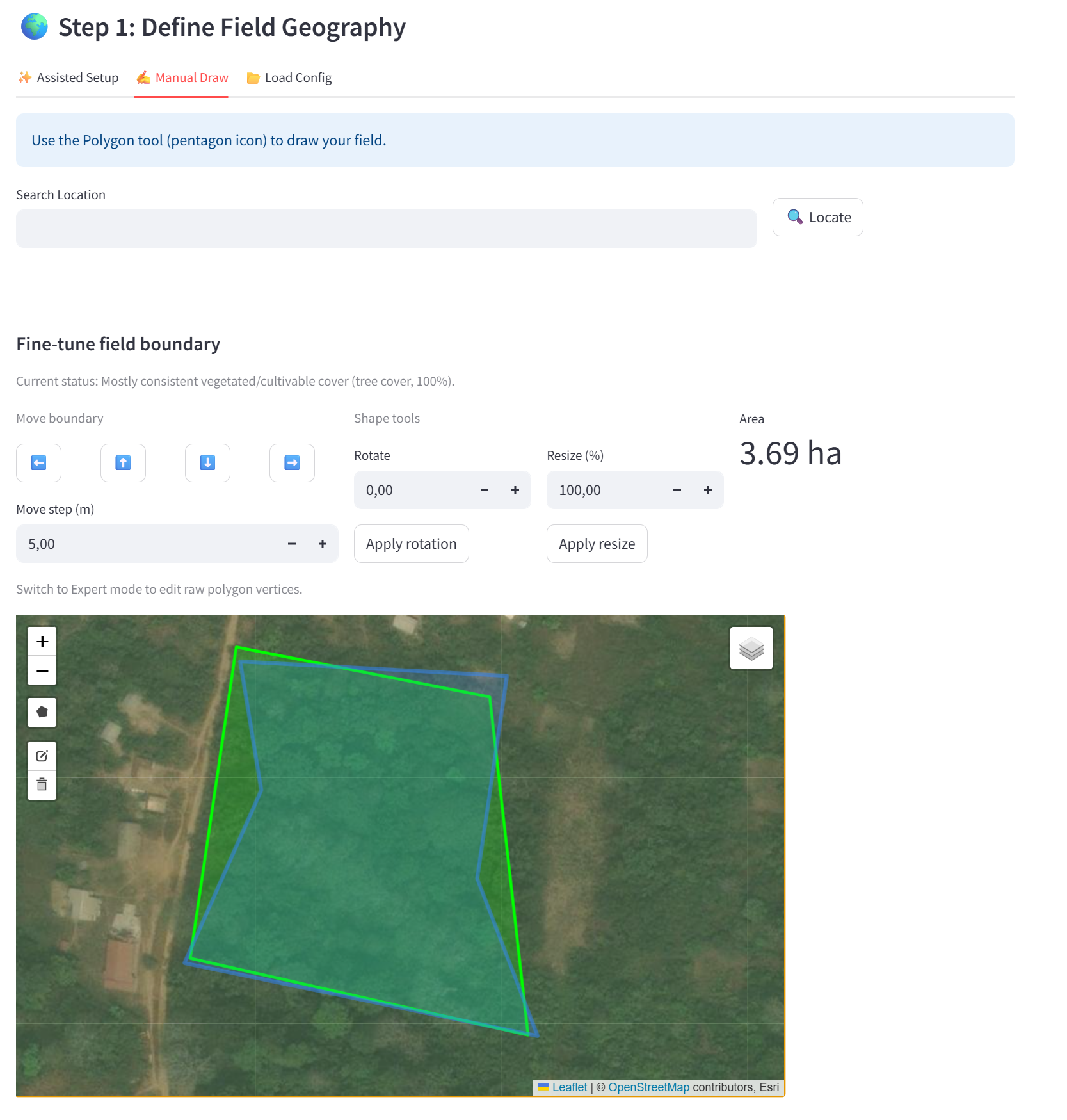
5

Smart editable boundary

The proposed boundary does not have to be square. It is a starting point that the user can correct according to field reality or satellite imagery.

Crop, variety and cycle
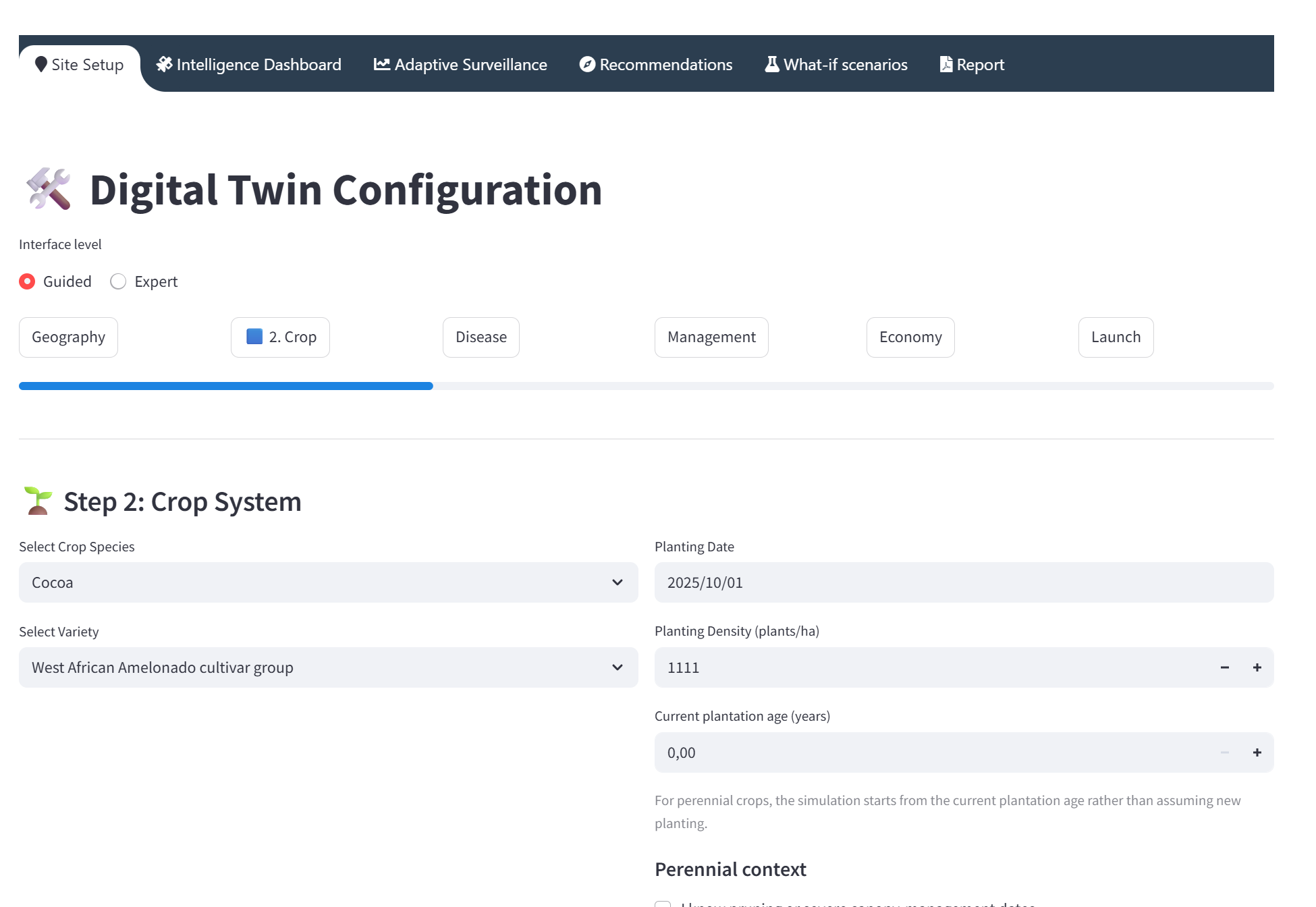
6

Crop, variety and cycle

AEF records crop, variety or varietal group, planting date, density and useful cycle parameters. For perennial crops, age and horizon become critical.

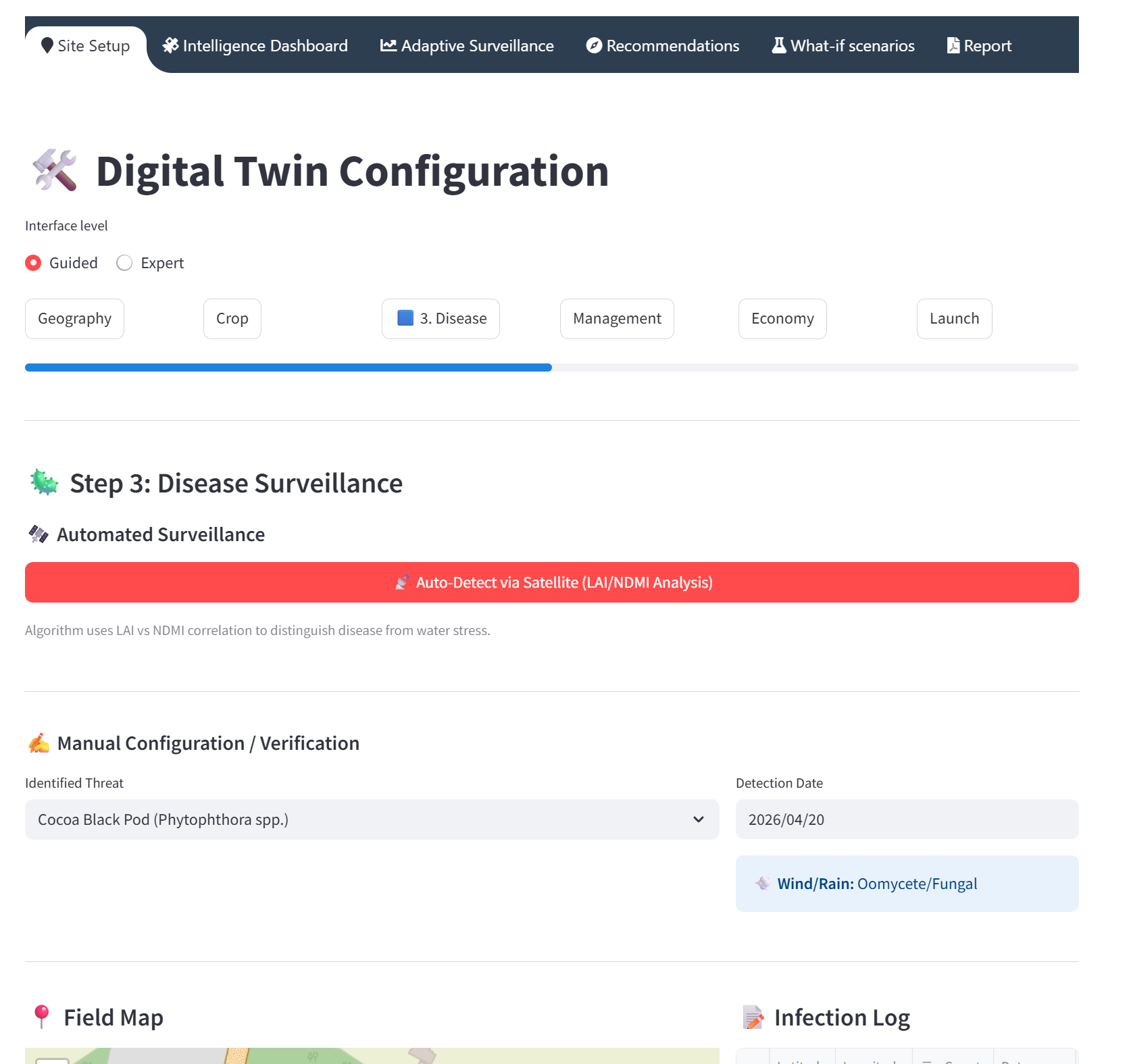
Cautious disease detection
7

Cautious disease detection

Disease can be configured manually or suspected from a canopy anomaly. The app does not claim satellite certainty; it proposes likely hypotheses for field validation.

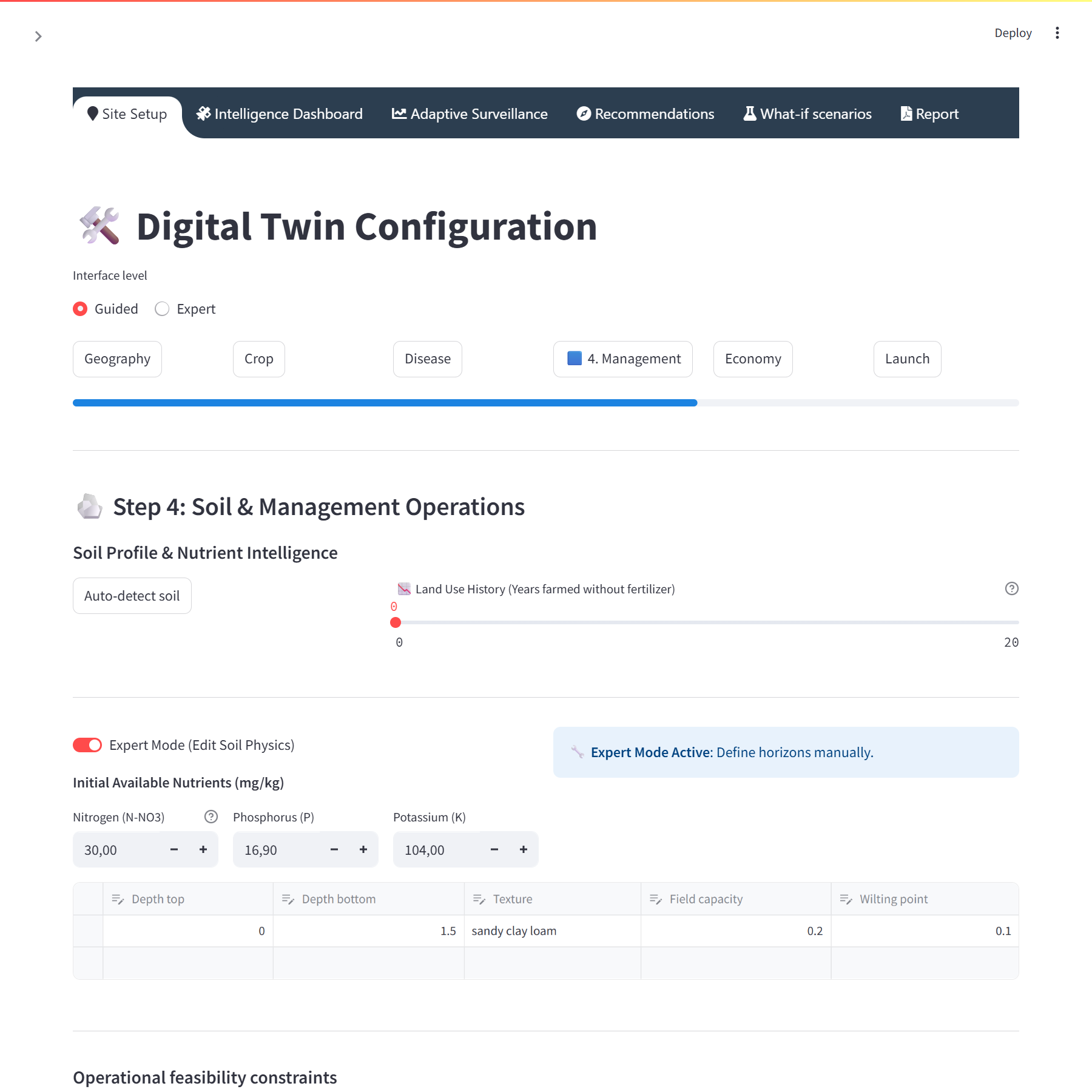
Soil and nutrients
8

Soil and nutrients

The user can combine automatic estimation, manual entry and expert mode. Initial nutrients, soil water and fertilization history structure later recommendations.

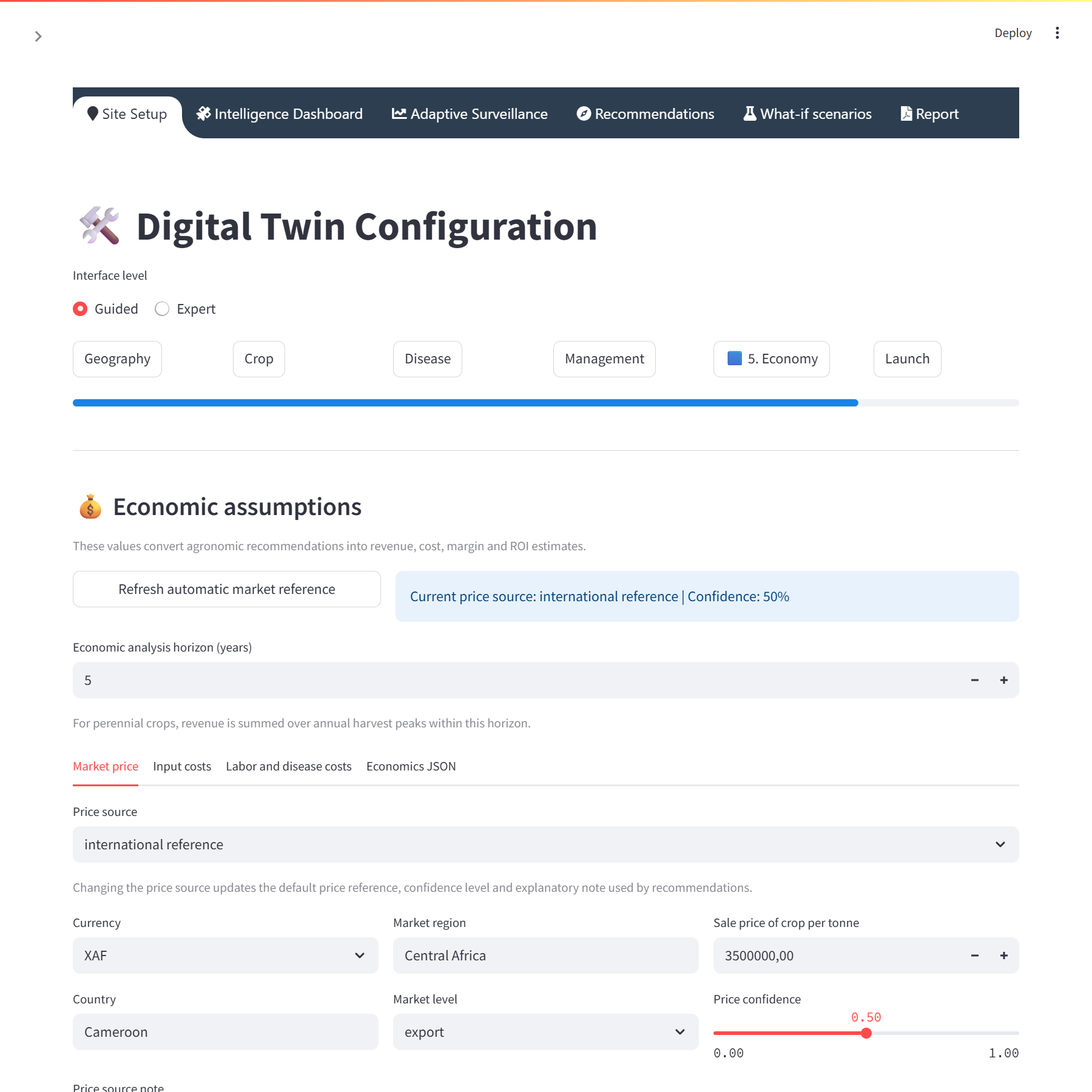
Configurable economics
9

Configurable economics

Sales price, fertilizer, irrigation, labour, spraying, pruning, roguing and replacement costs turn agronomic diagnosis into economic decisions.

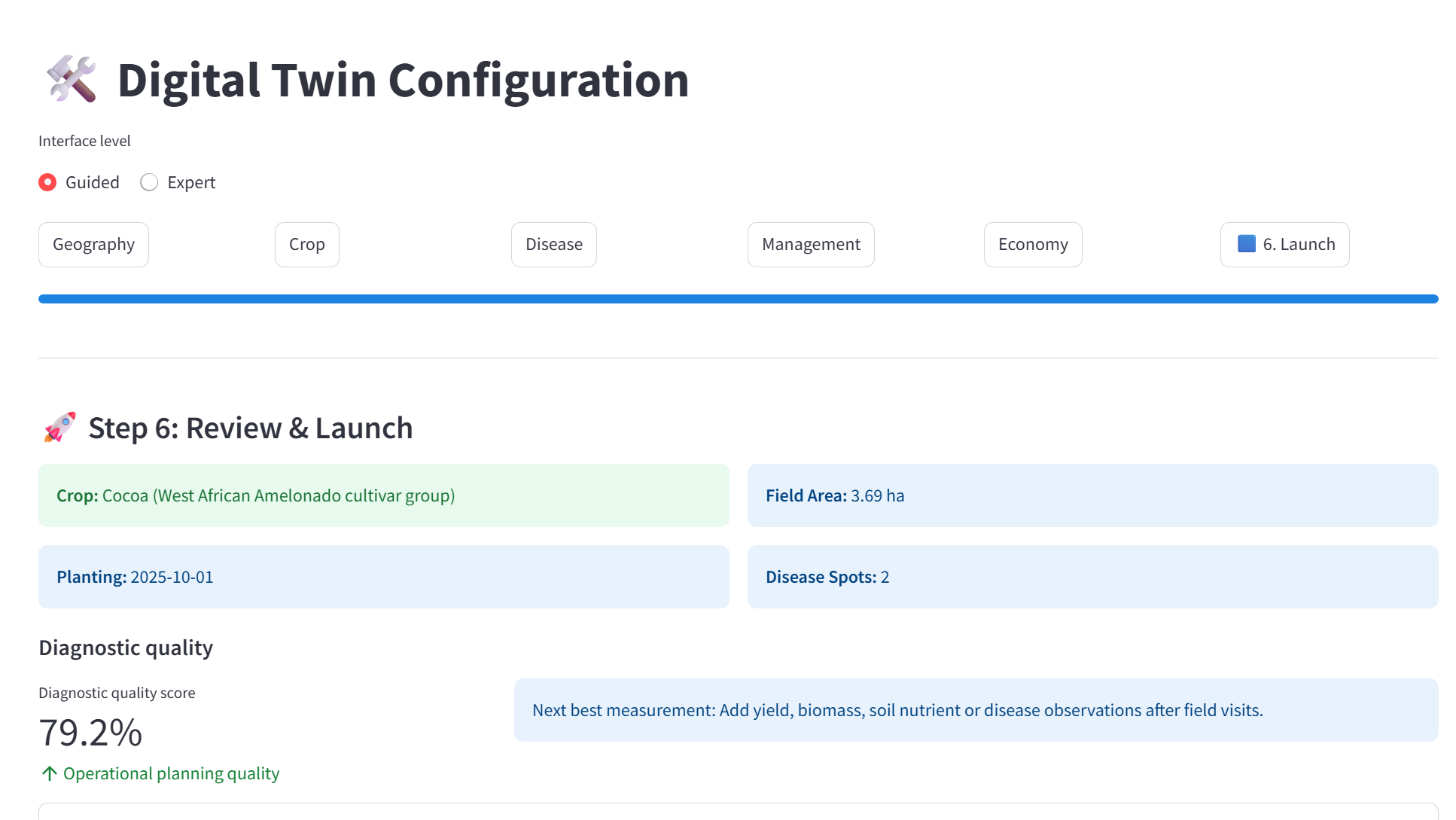
Review before simulation
10

Review before simulation

Before launching the digital twin, AEF summarizes assumptions. This protects against input errors that could make forecasts misleading.

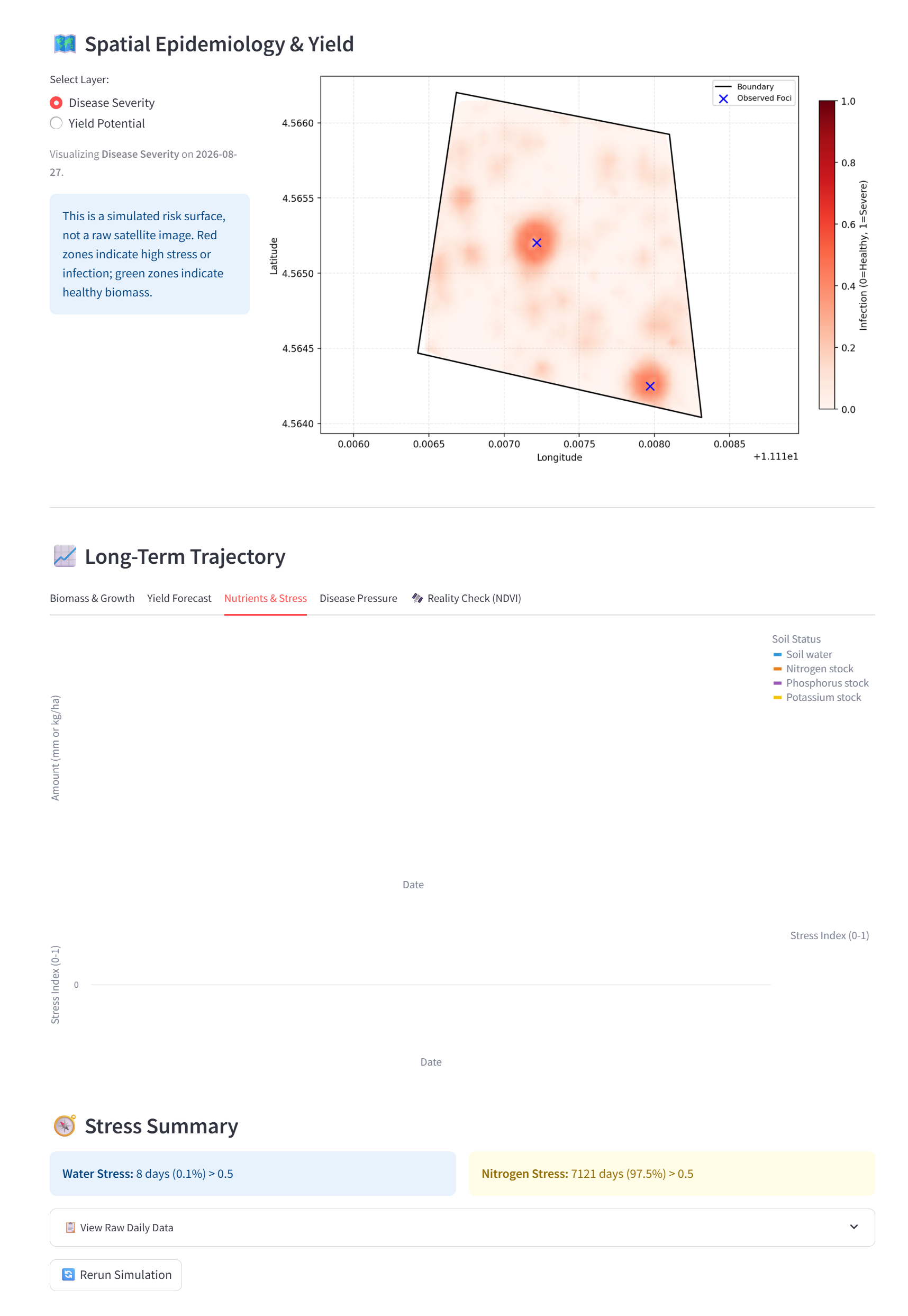
Forecast dashboard
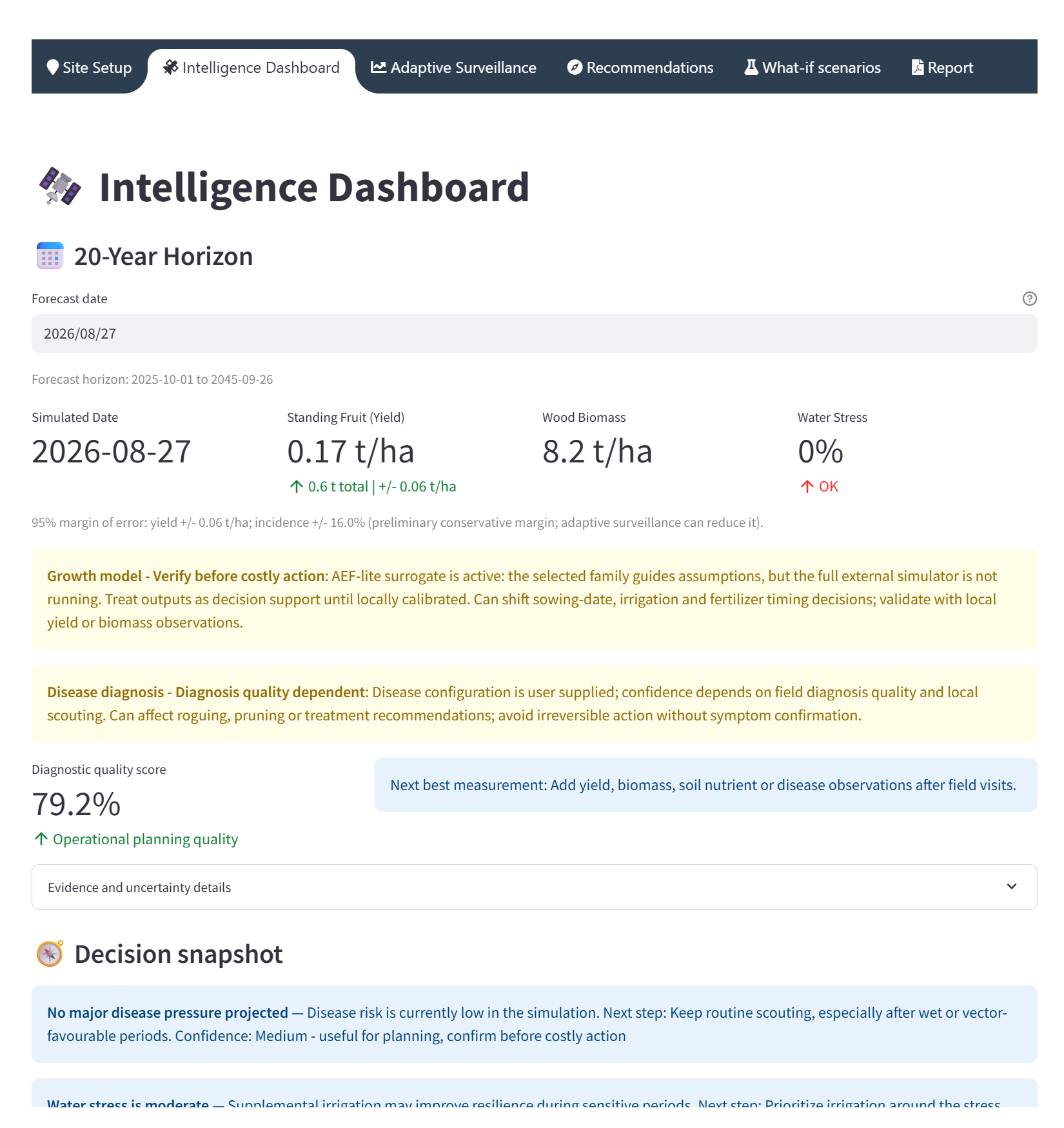
11

Forecast dashboard

The dashboard combines yield, water stress, nutrient stress, disease, production and maps. It allows quick exploration of future field states.

Future date and uncertainty
12

Future date and uncertainty

Calendar-based date selection makes forecasting more intuitive. Error margins remind users that the model is cautious and field calibration is needed.

Prepare optimization
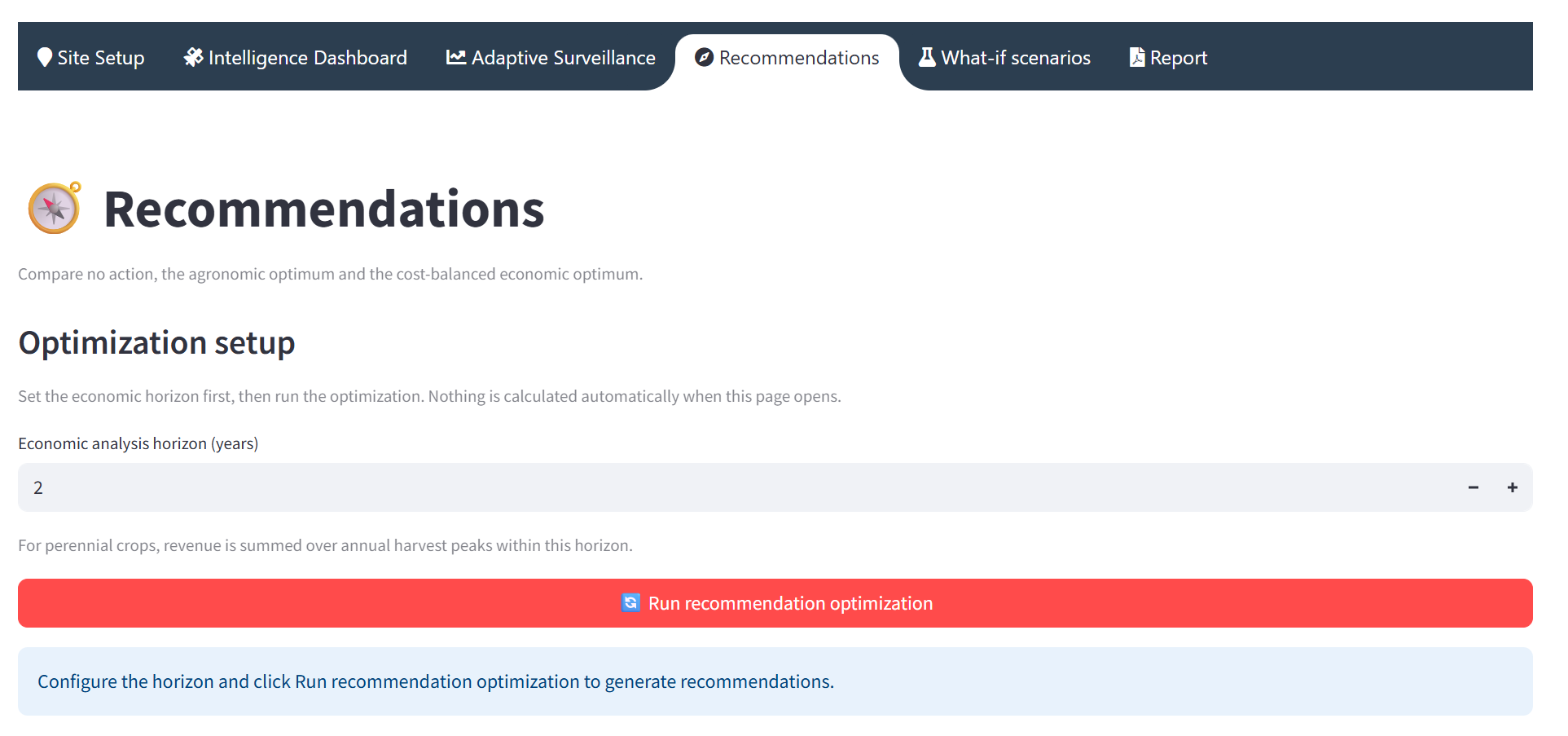
13

Prepare optimization

Recommendations are not launched automatically. The user configures the horizon when relevant, especially for perennial crops such as cocoa.

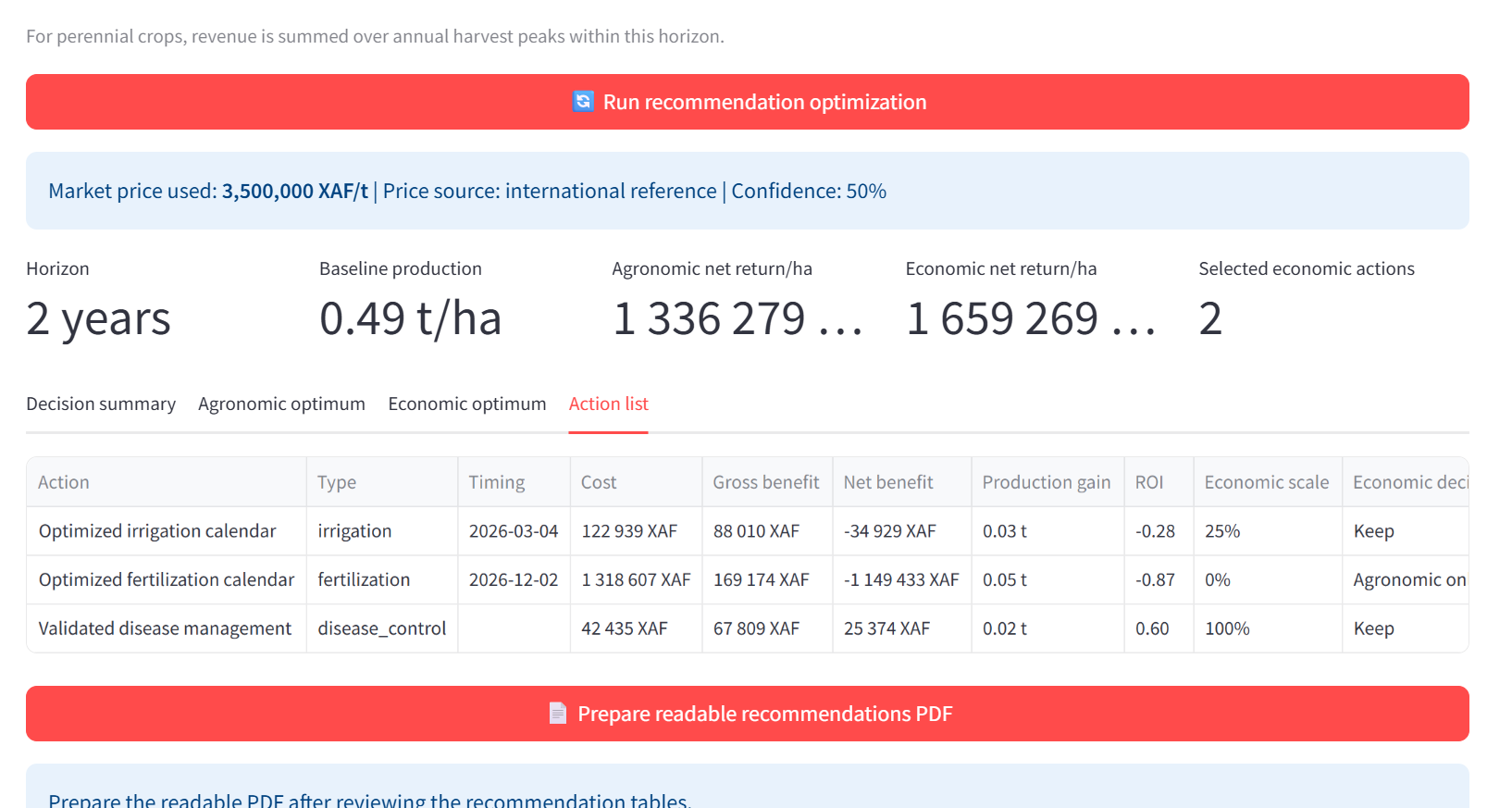
Compare strategies
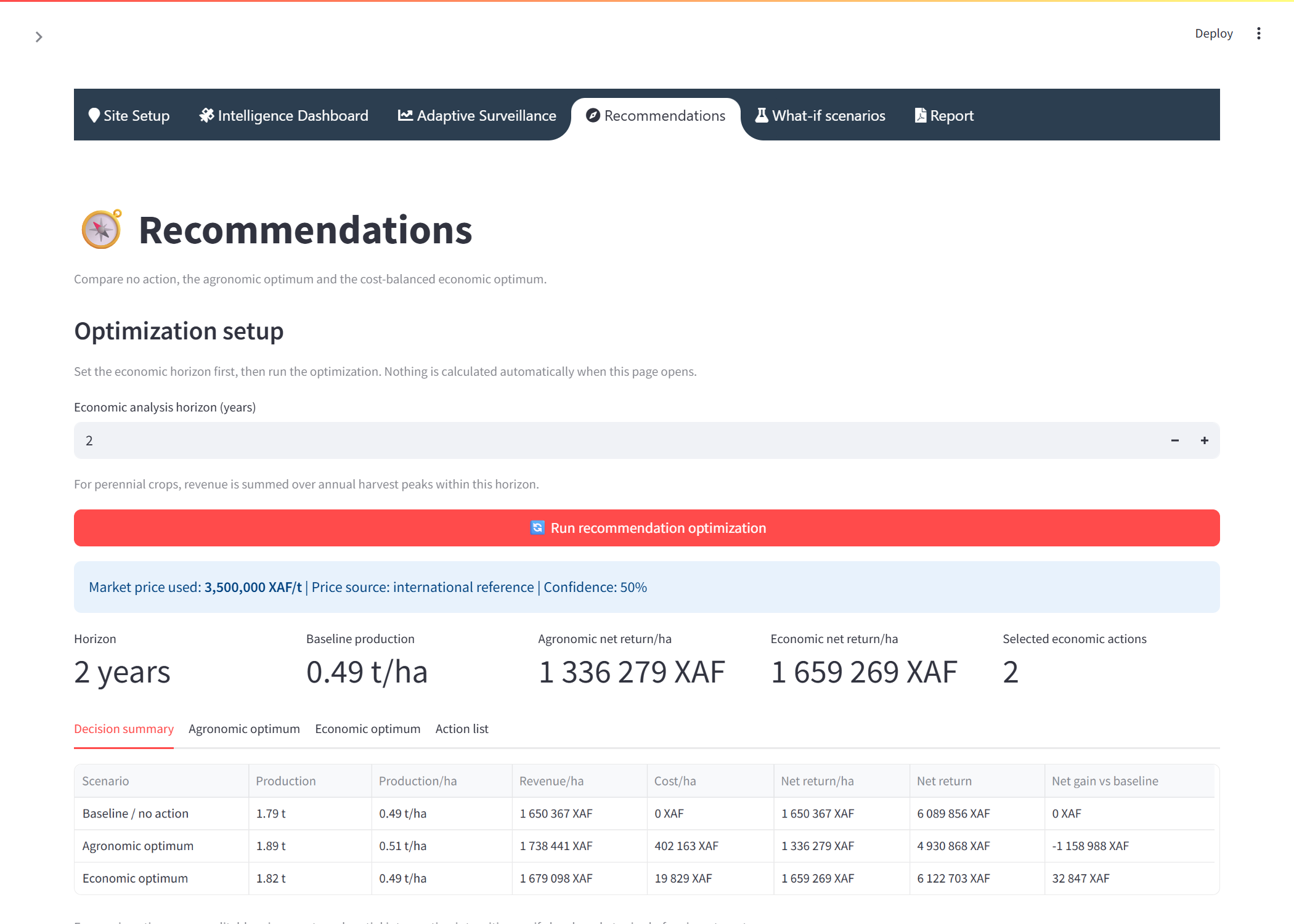
14

Compare strategies

AEF separates baseline, agronomic optimum and economic optimum. The economic optimum seeks the best net margin, not only the highest yield.

Calendars and disease control
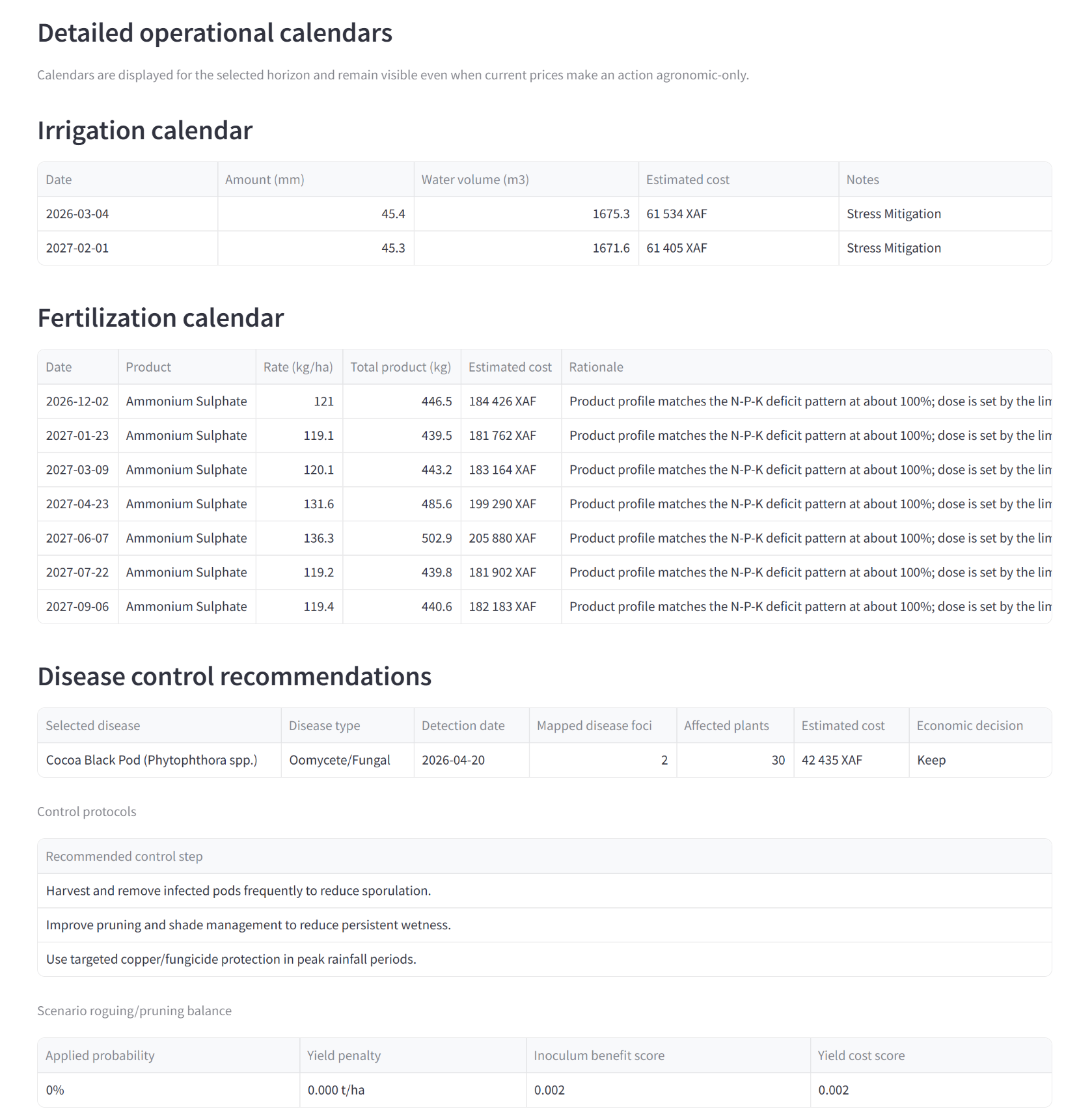
15

Calendars and disease control

One screen can group irrigation, fertilization and disease-control recommendations. Roguing or pruning must compare inoculum reduction, cost and yield loss.

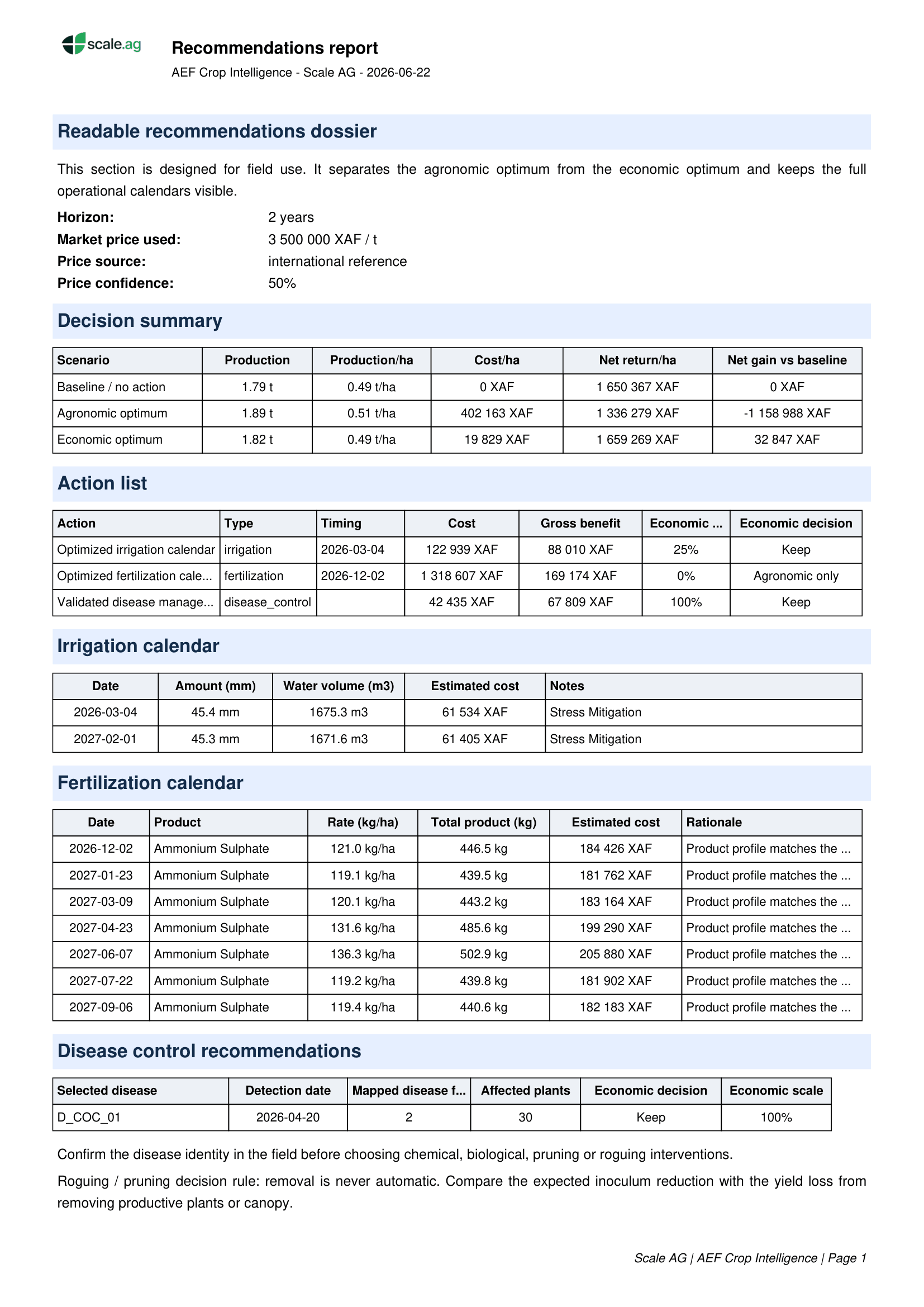
Recommendations report 1/2
16

Recommendations report 1/2

The recommendations PDF presents strategy comparison, per-hectare costs and first actions. It is meant for field use, not only technical review.

Recommendations report 2/2
17

Recommendations report 2/2

The continuation details operational calendars and recommendations. Long tables live in the PDF so the interface remains lighter.

PDF download
18

PDF download

Recommendations can be exported as a readable document for farmers, cooperatives, advisors or funders.

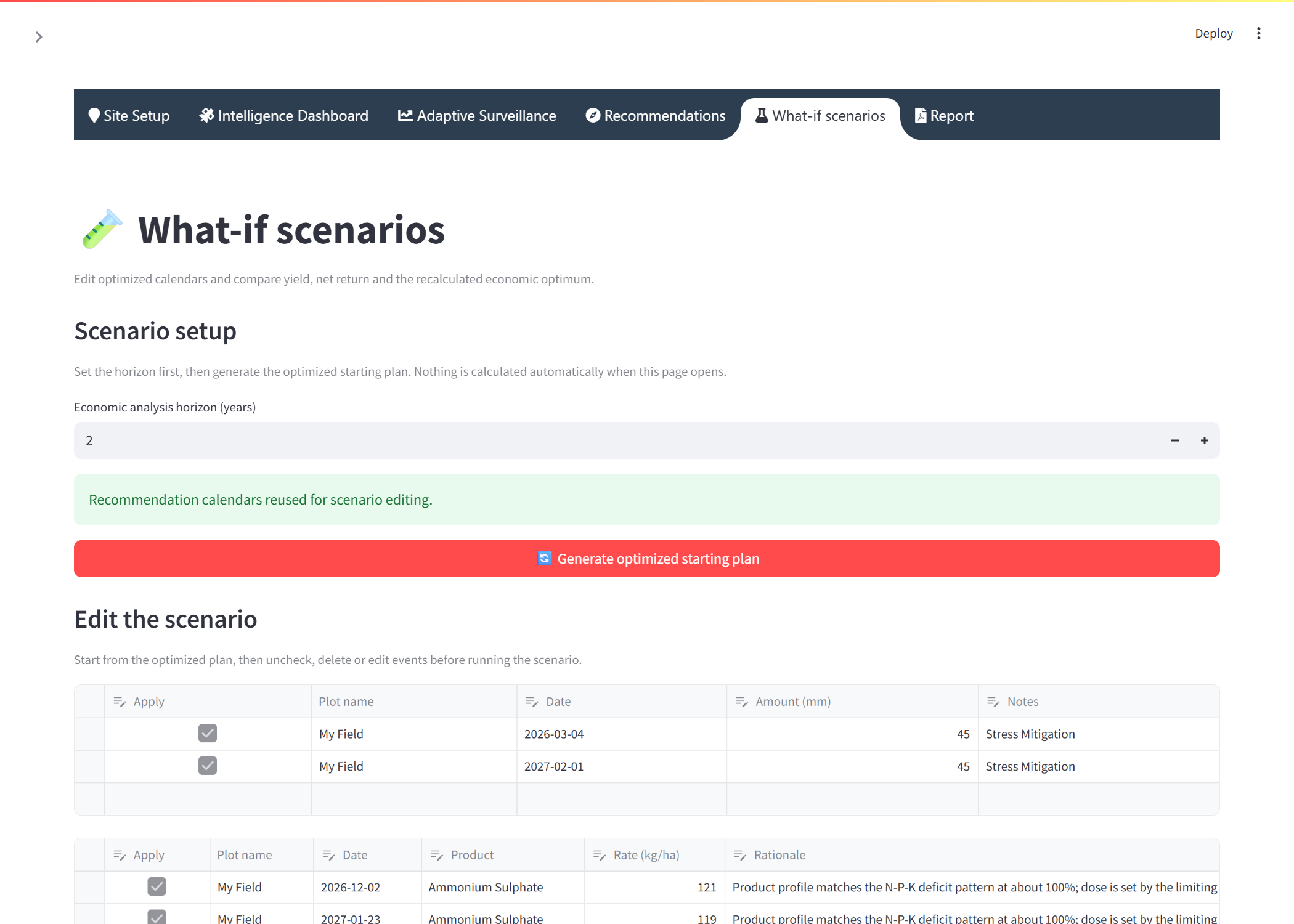
What-if: start from the optimized plan
19

What-if: start from the optimized plan

Scenario mode loads the recommended plan first. The user can then test what happens when some actions are impossible or too costly.

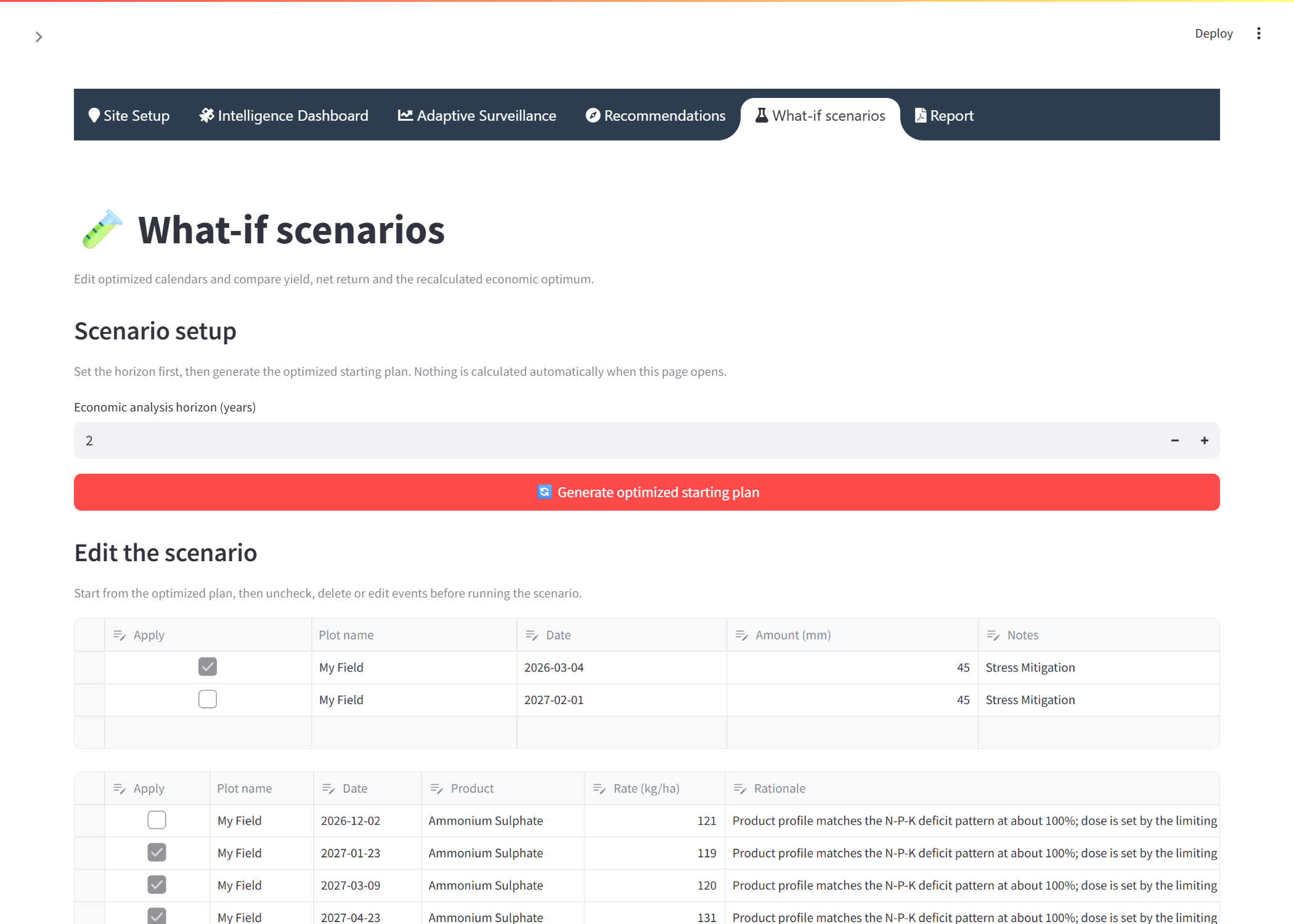
Edit a plan and measure impact
20

Edit a plan and measure impact

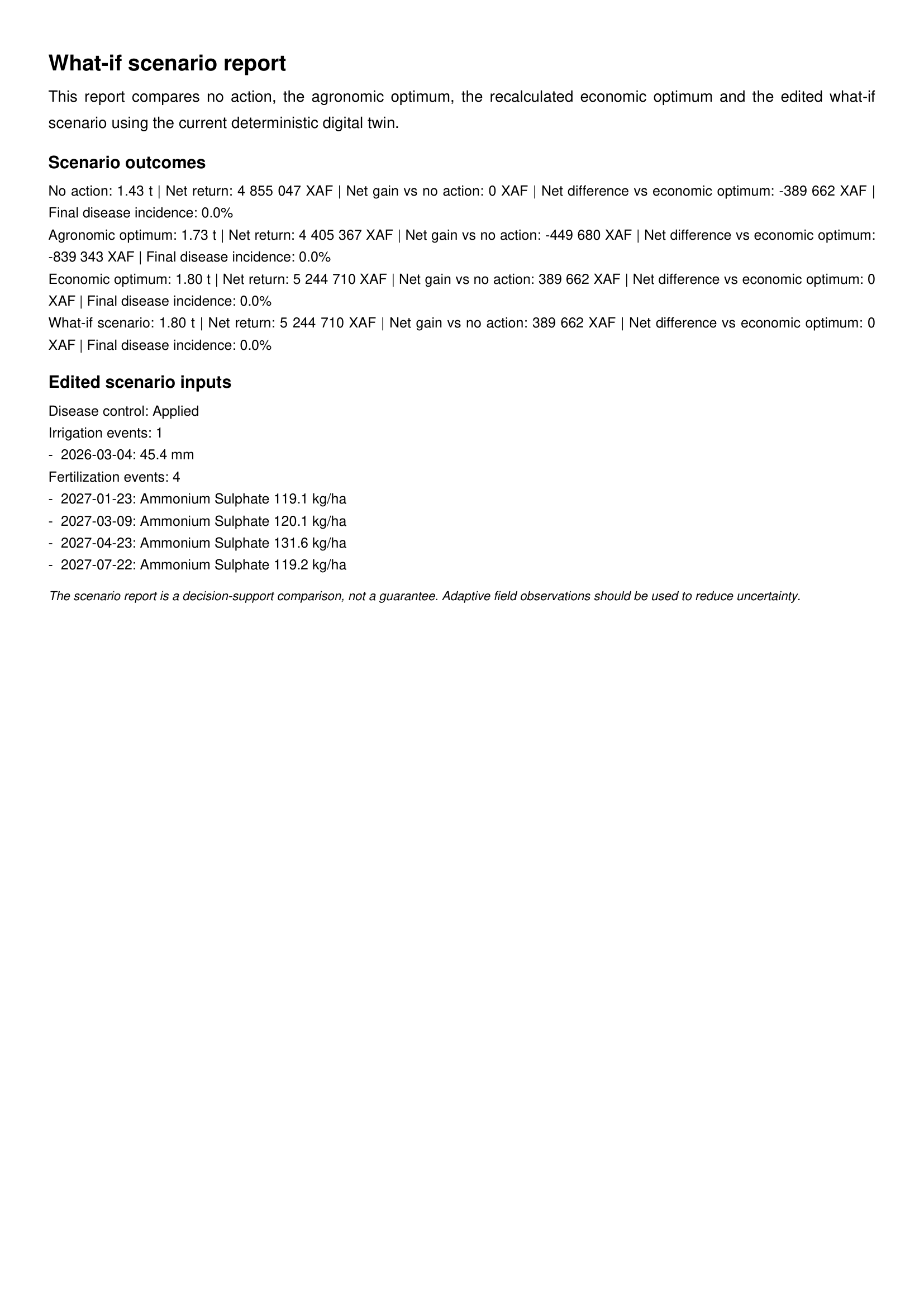
Moving or removing irrigation, fertilization or disease control recalculates yield and economic return. The scenario supports real-world feasibility discussion.

Scenario PDF
21

Scenario PDF

What-if scenarios can be documented as PDF to keep a clear record of trade-offs.

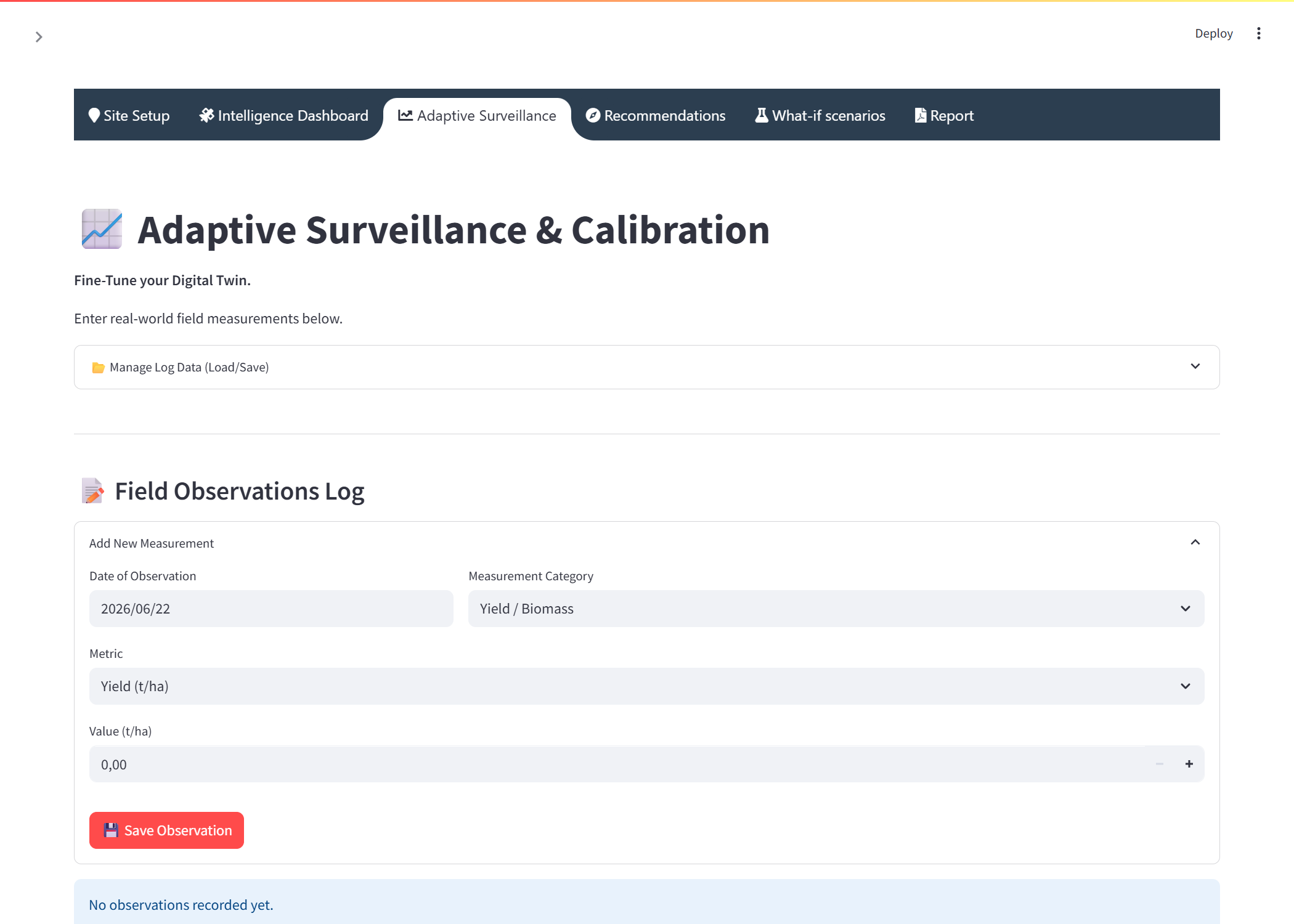
Adaptive surveillance
22

Adaptive surveillance

Field observations progressively reduce uncertainty: yield, biomass, nutrients, water or disease incidence can feed calibration.

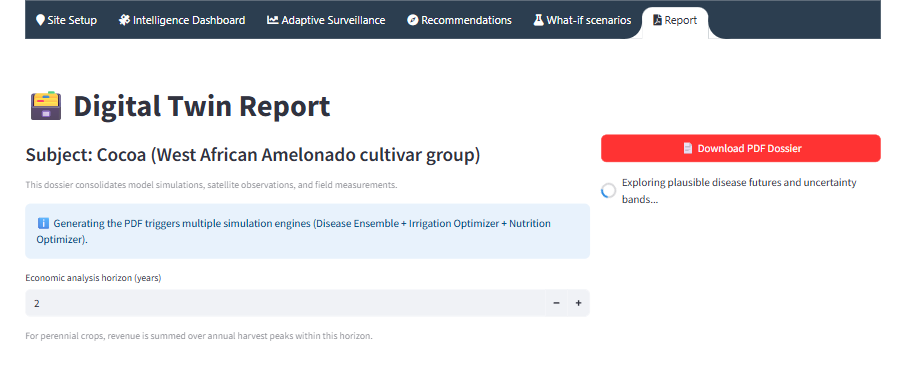
Generate final report
23

Generate final report

The final report gathers diagnosis, simulations, recommendations, economics, calendars and model limits into one dossier.

Cooperative mode
24

Cooperative mode

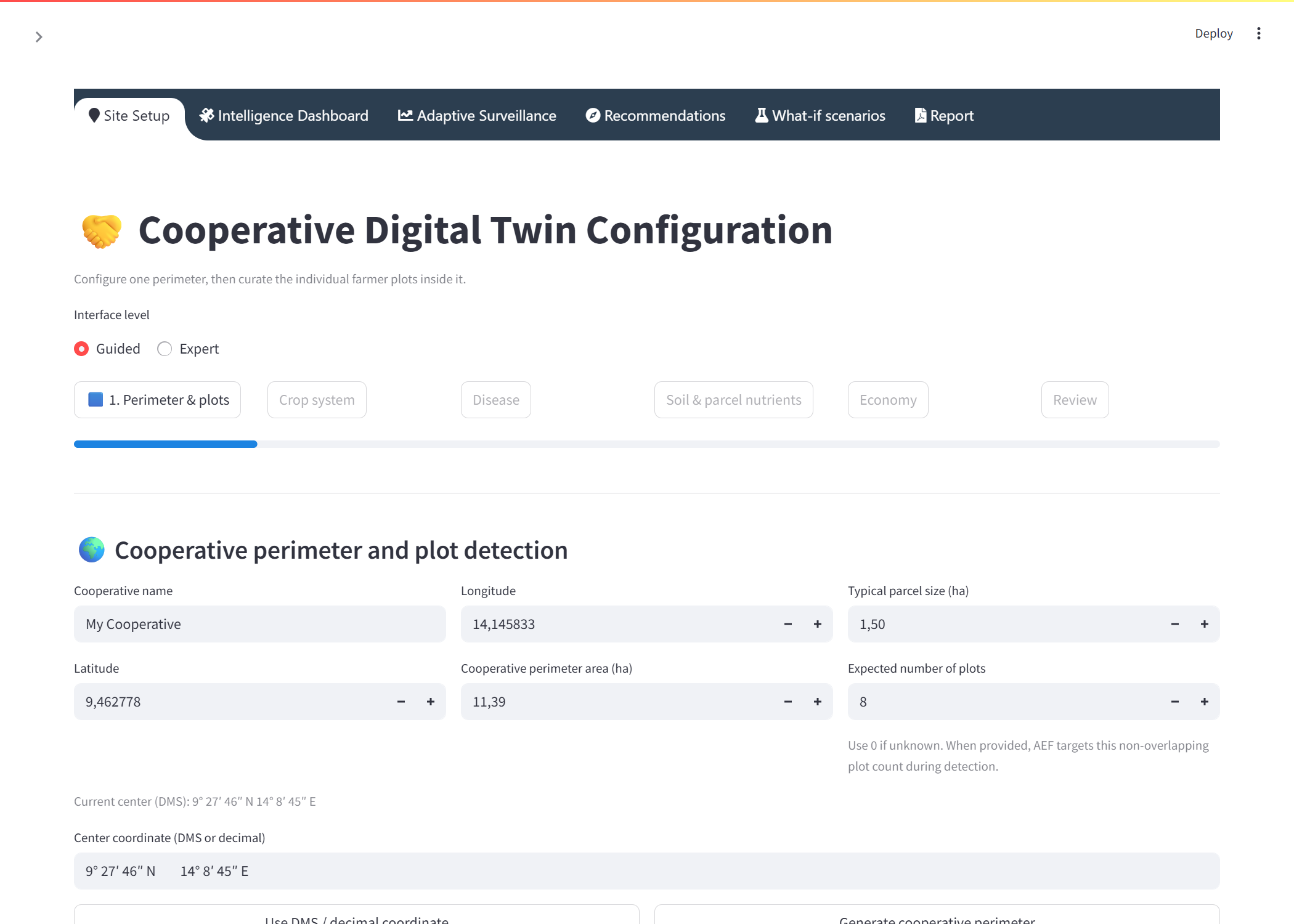
This mode addresses perimeters made of many small plots. It fits cooperatives, extension companies, agricultural projects and producer organizations.

Cooperative perimeter
25

Cooperative perimeter

The user defines a global perimeter. AEF accepts that it may contain wide non-cultivated gaps: roads, water, fallows, buildings, bare areas or unplanted spaces.

Detected cooperative plots
26

Detected cooperative plots

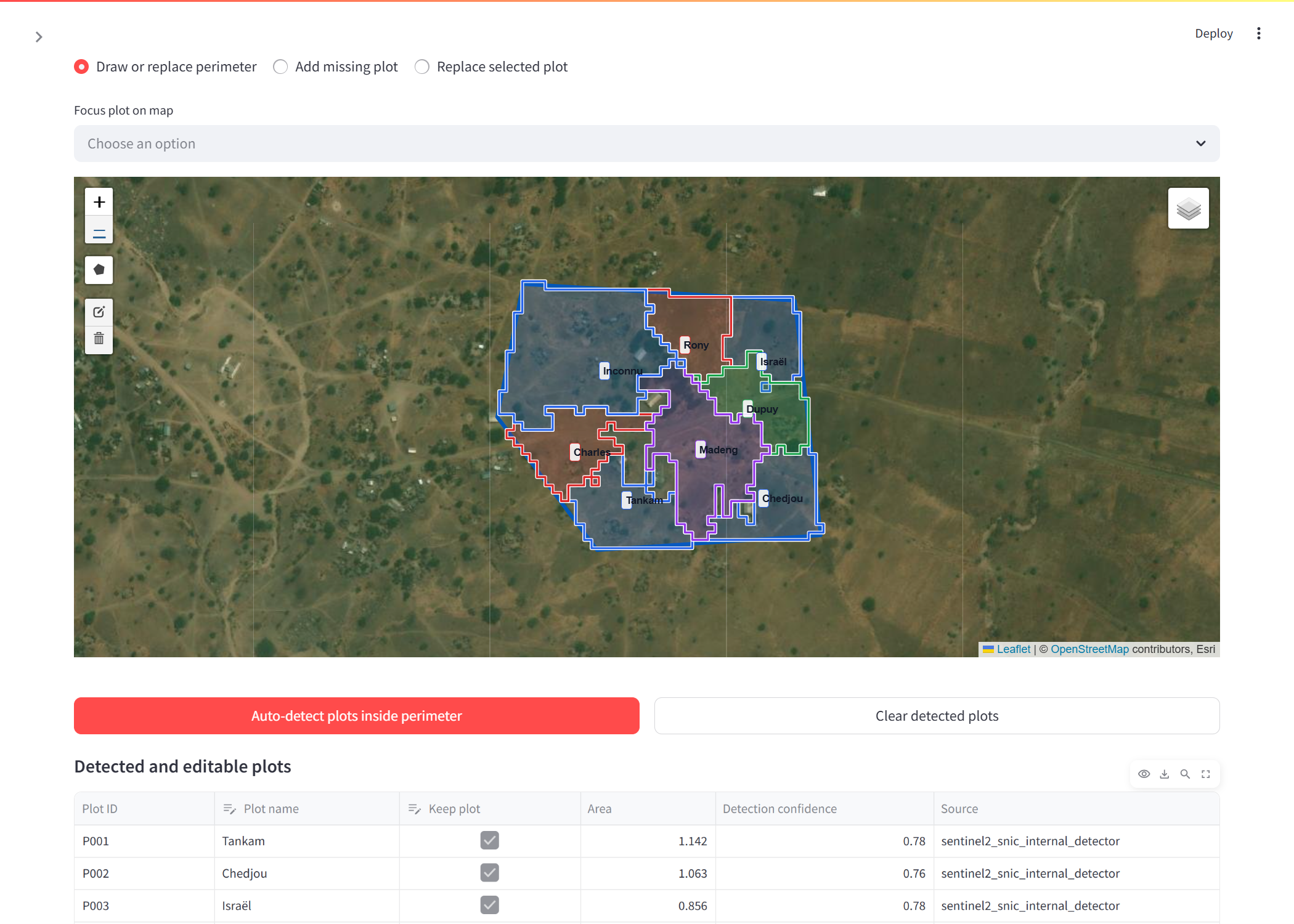
The algorithm seeks non-overlapping plots without blindly filling the whole perimeter. Plots remain editable, nameable and open to validation.

Pre-planting assessment
27

Pre-planting assessment

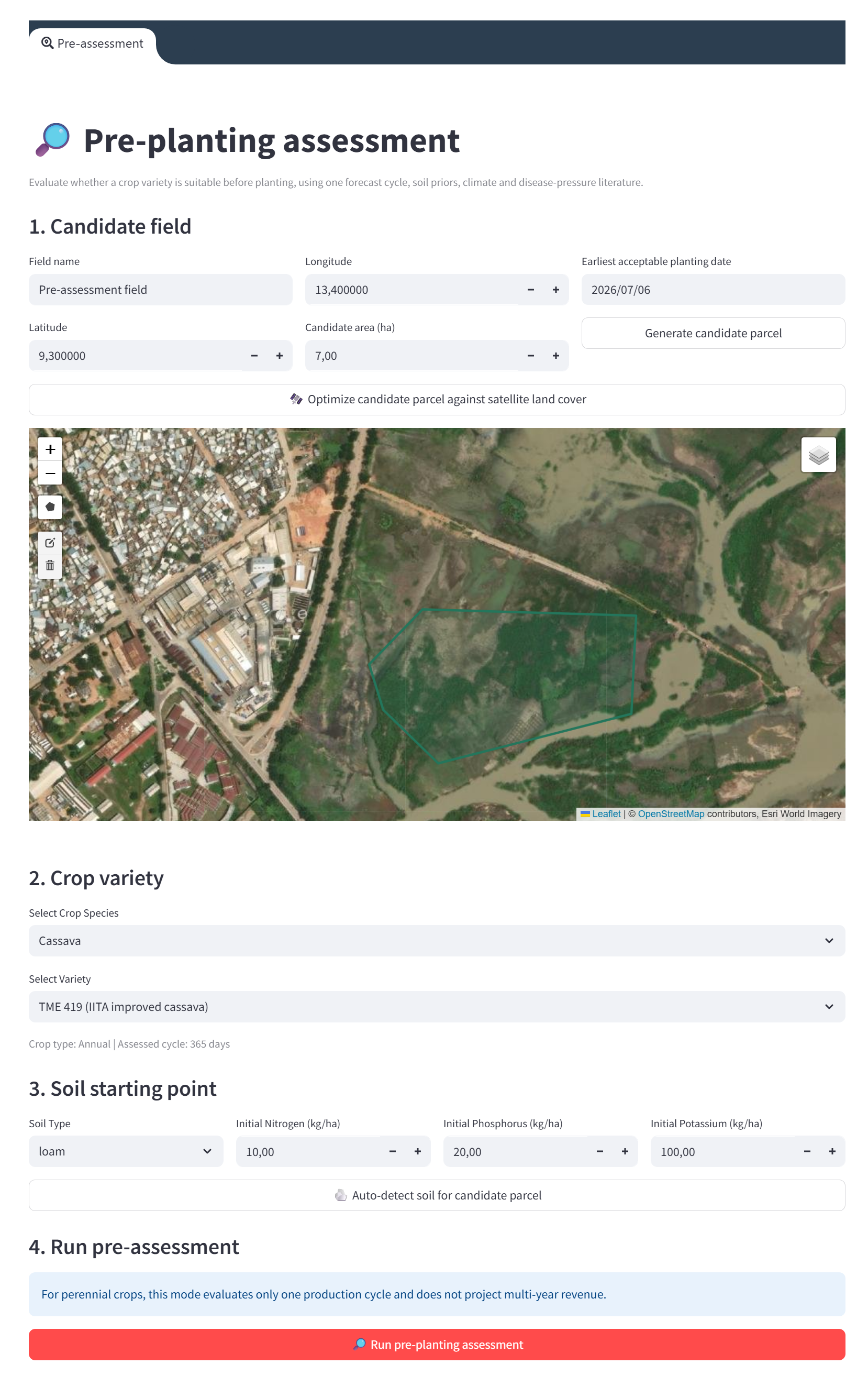
This mode helps decide whether an uncultivated area suits a crop and variety. It analyzes soil, forecast climate, regional disease pressure and management needs over one cycle.

Score and final recommendation
28

Score and final recommendation

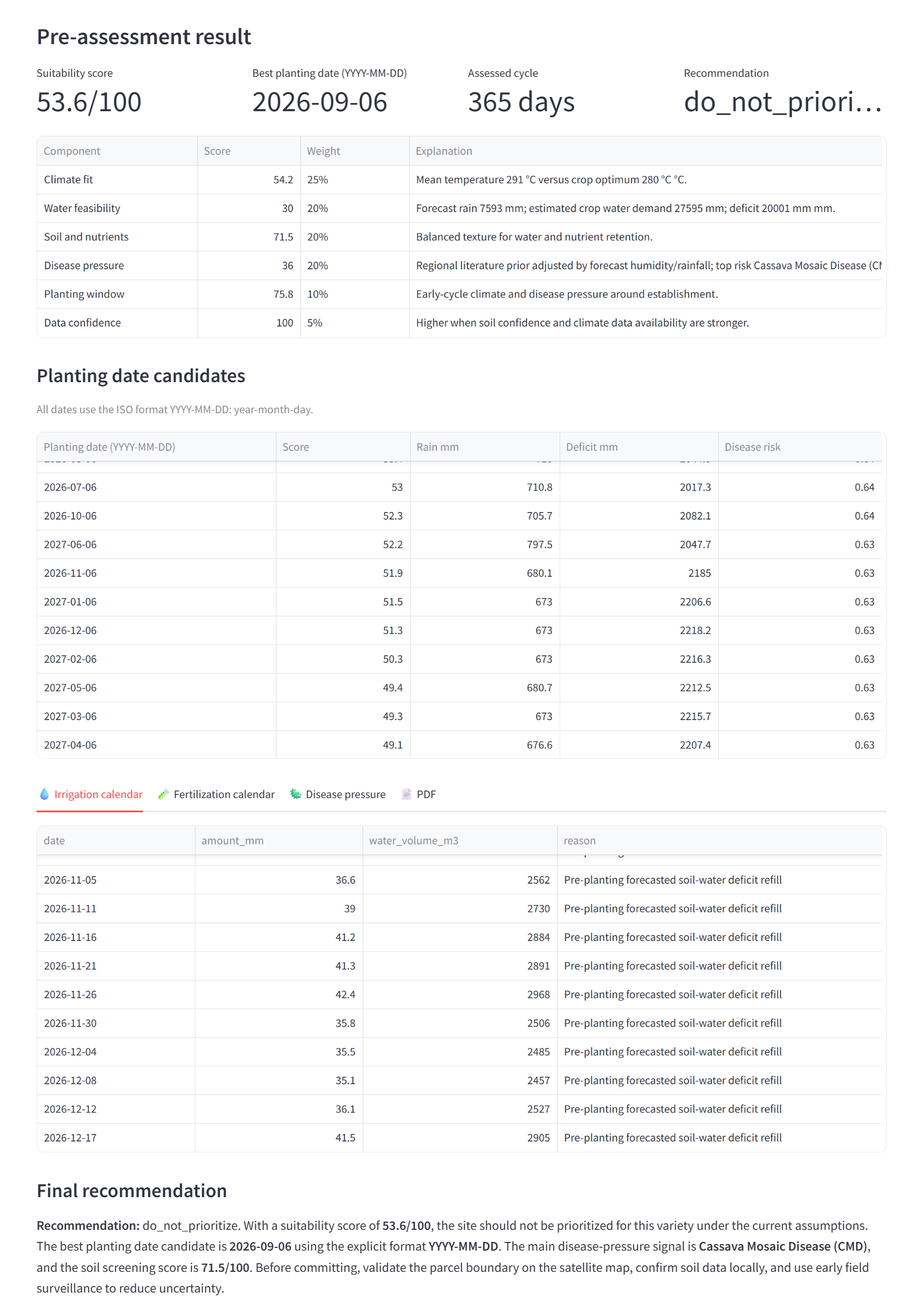
Pre-assessment ends with a score, explicit date candidates and a recommendation paragraph. The goal is to support decisions before investment.

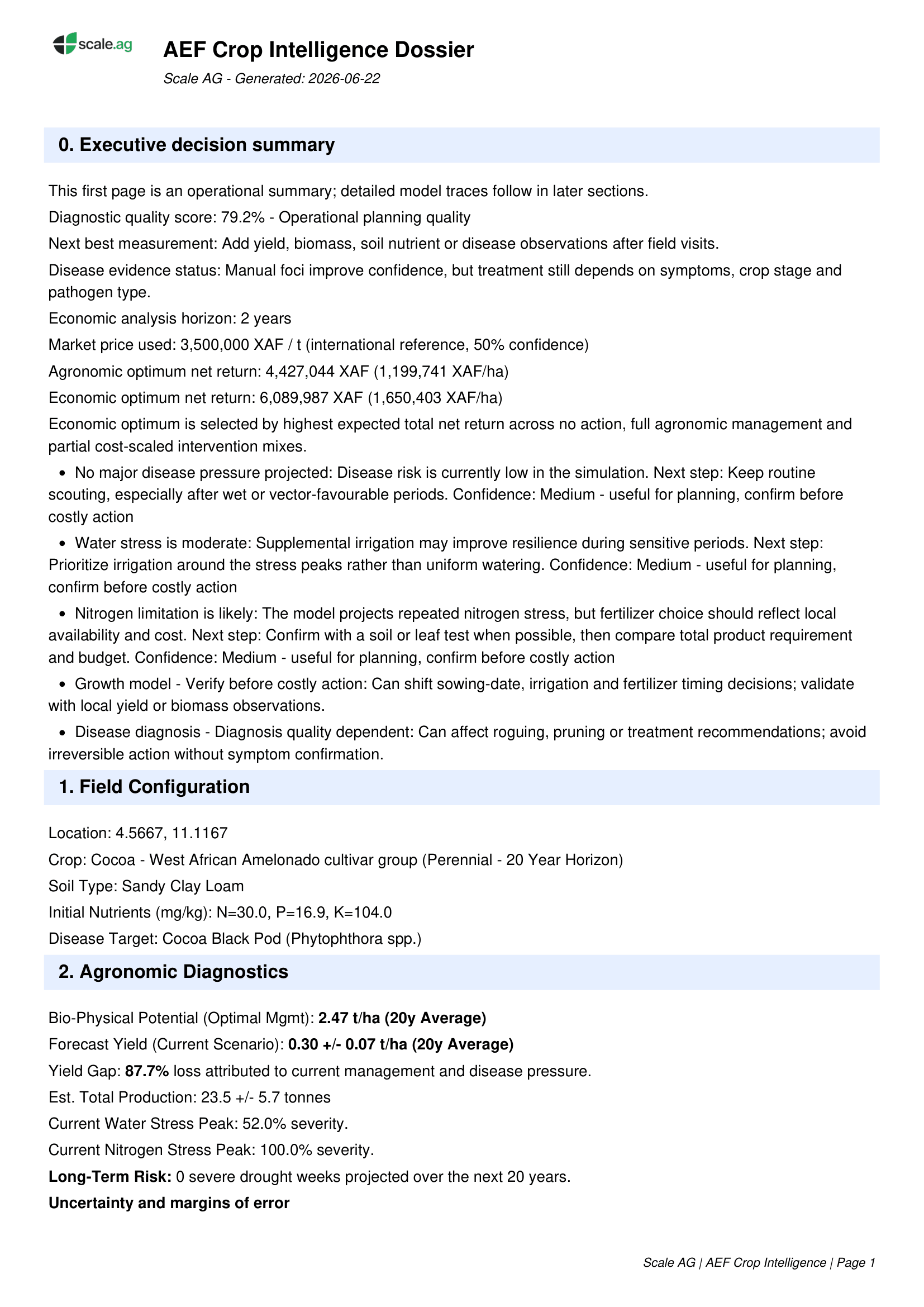
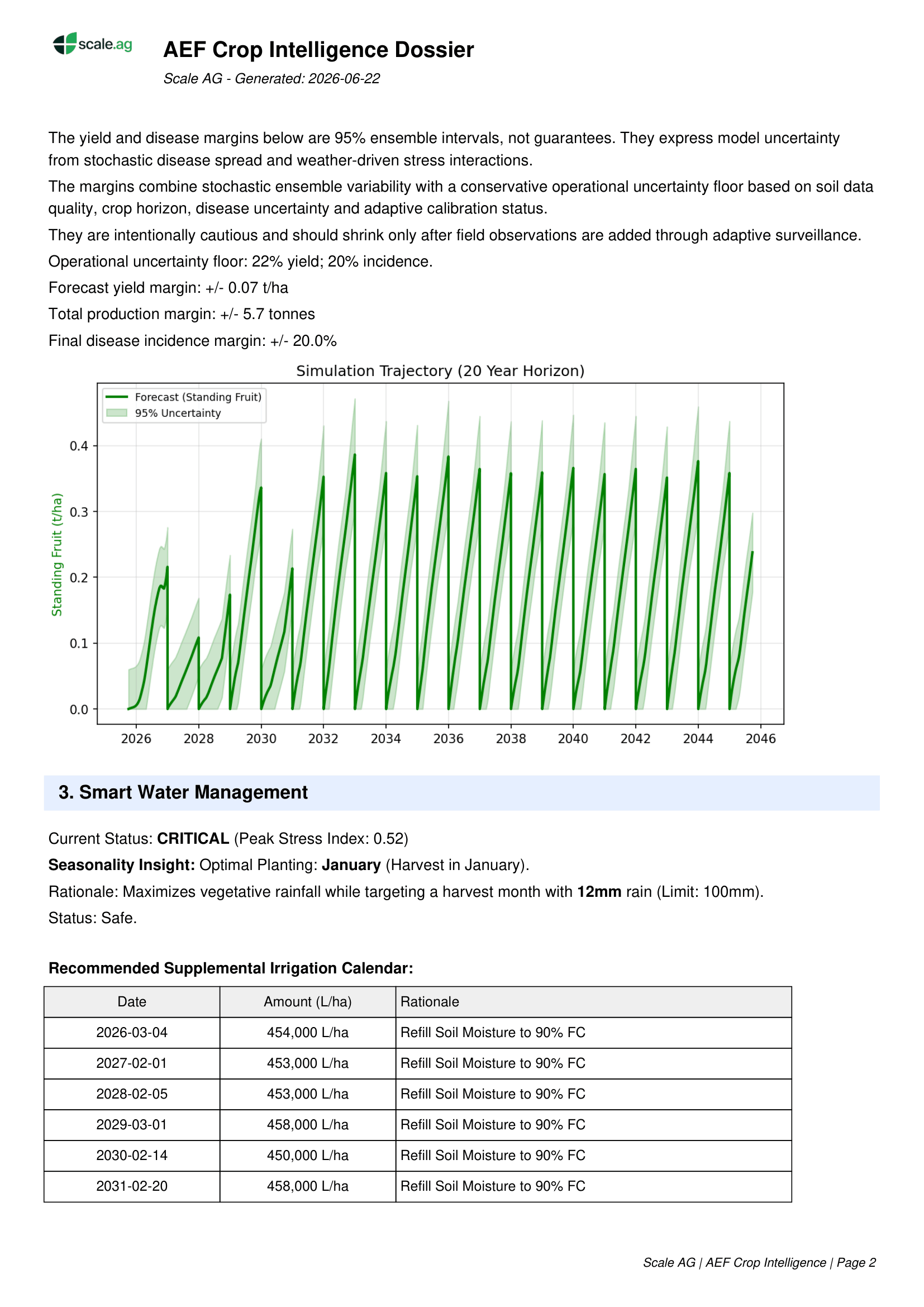
Generated final report

The final dossier brings together assumptions, forecasts, recommendations, calendars, economics and model limits in a shareable document.
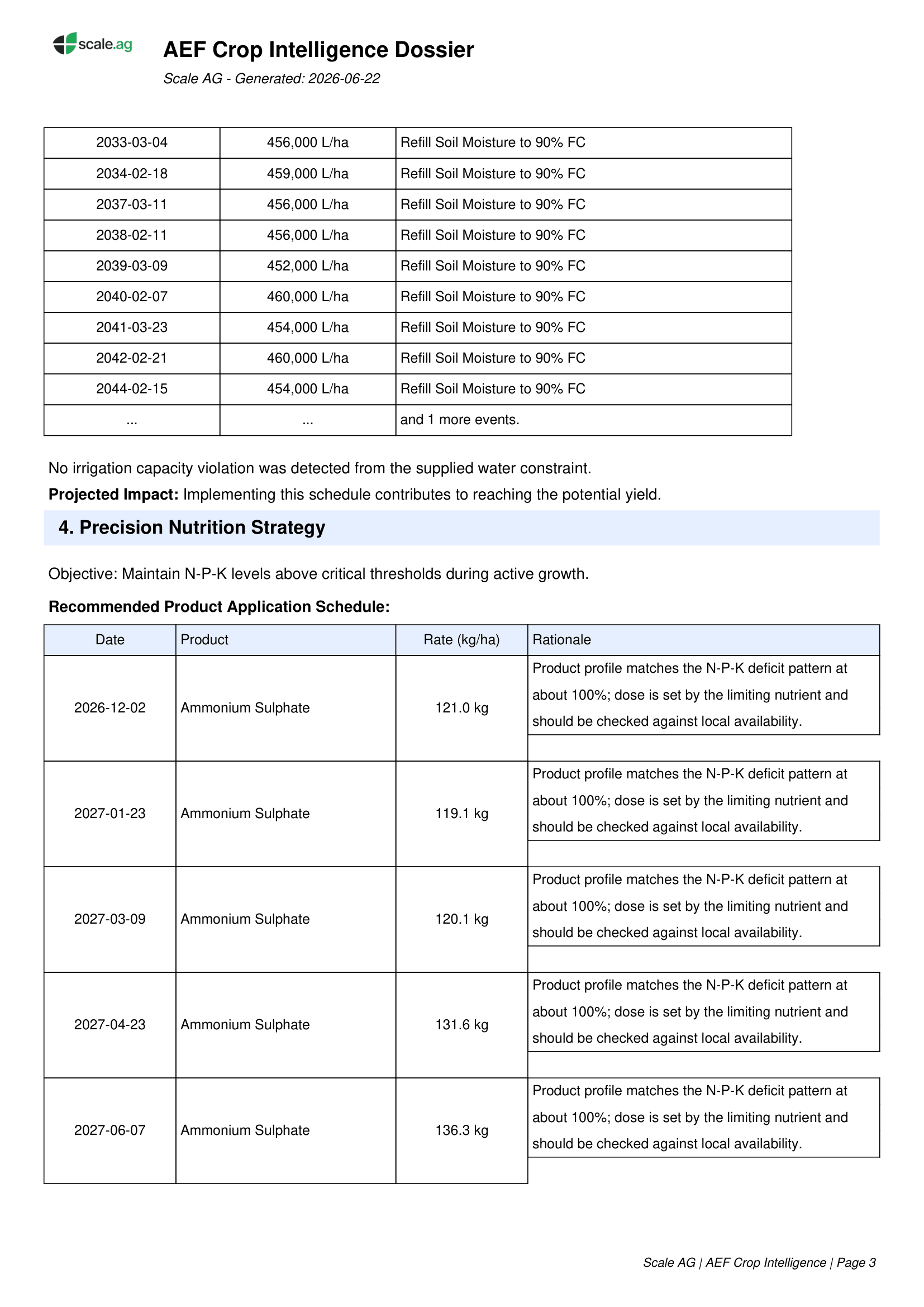
Generated final report - page 1
PDF 1/9

Generated final report - page 1

Extract from the final dossier generated by AEF Crop Intelligence for the cocoa case presented.

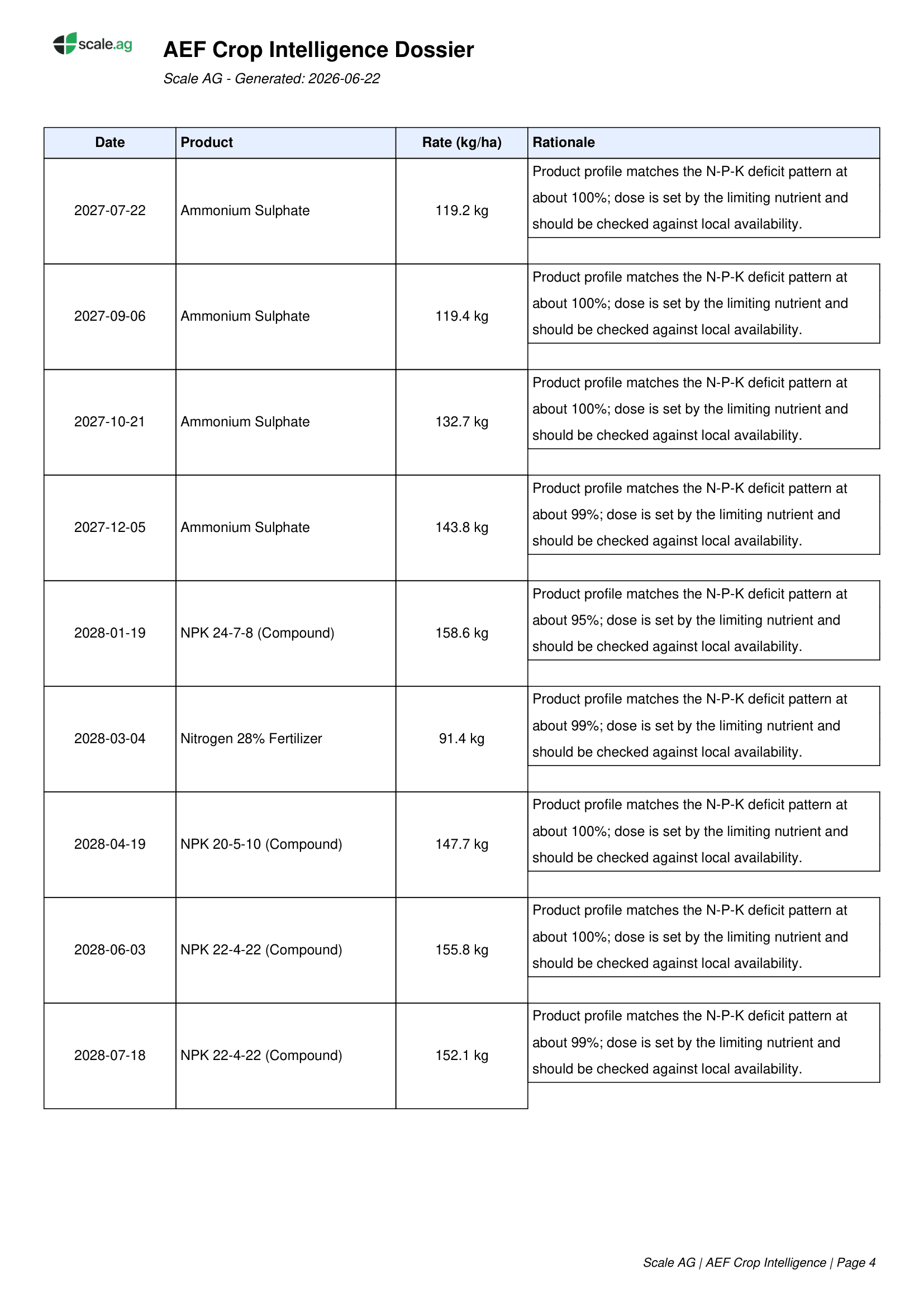
Generated final report - page 2
PDF 2/9

Generated final report - page 2

Extract from the final dossier generated by AEF Crop Intelligence for the cocoa case presented.

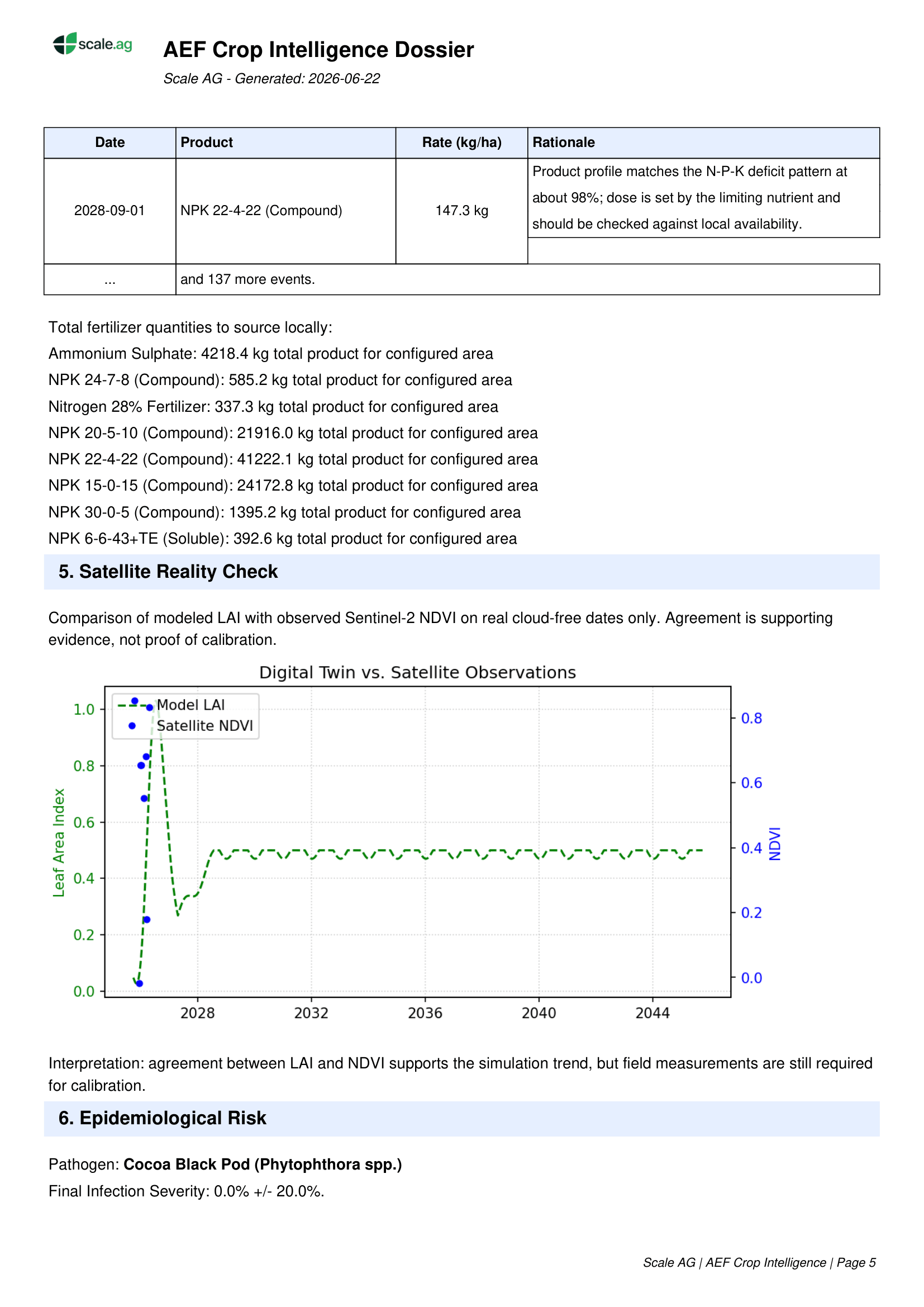
Generated final report - page 3
PDF 3/9

Generated final report - page 3

Extract from the final dossier generated by AEF Crop Intelligence for the cocoa case presented.

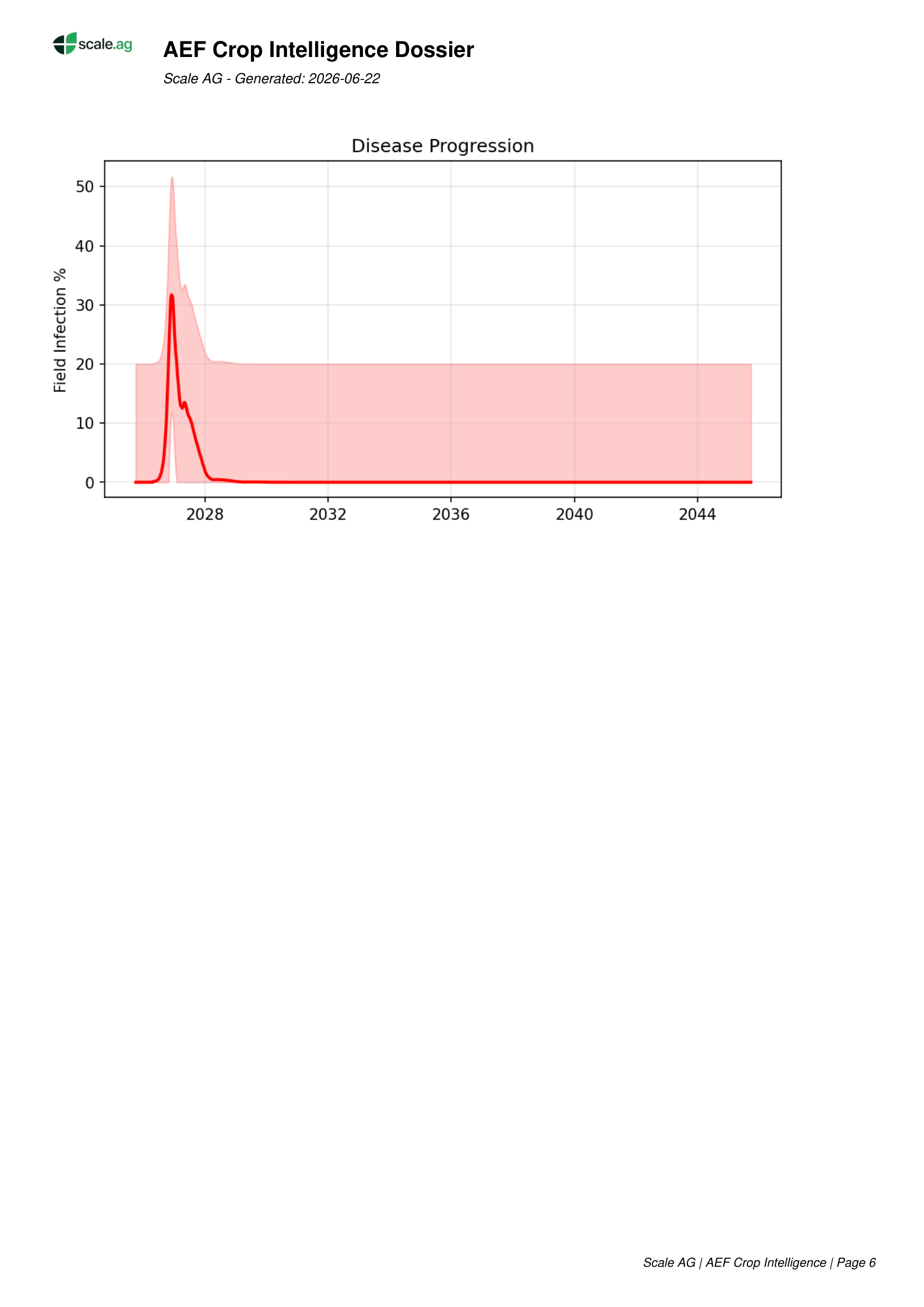
Generated final report - page 4
PDF 4/9

Generated final report - page 4

Extract from the final dossier generated by AEF Crop Intelligence for the cocoa case presented.

Generated final report - page 5
PDF 5/9

Generated final report - page 5

Extract from the final dossier generated by AEF Crop Intelligence for the cocoa case presented.

Generated final report - page 6
PDF 6/9

Generated final report - page 6

Extract from the final dossier generated by AEF Crop Intelligence for the cocoa case presented.

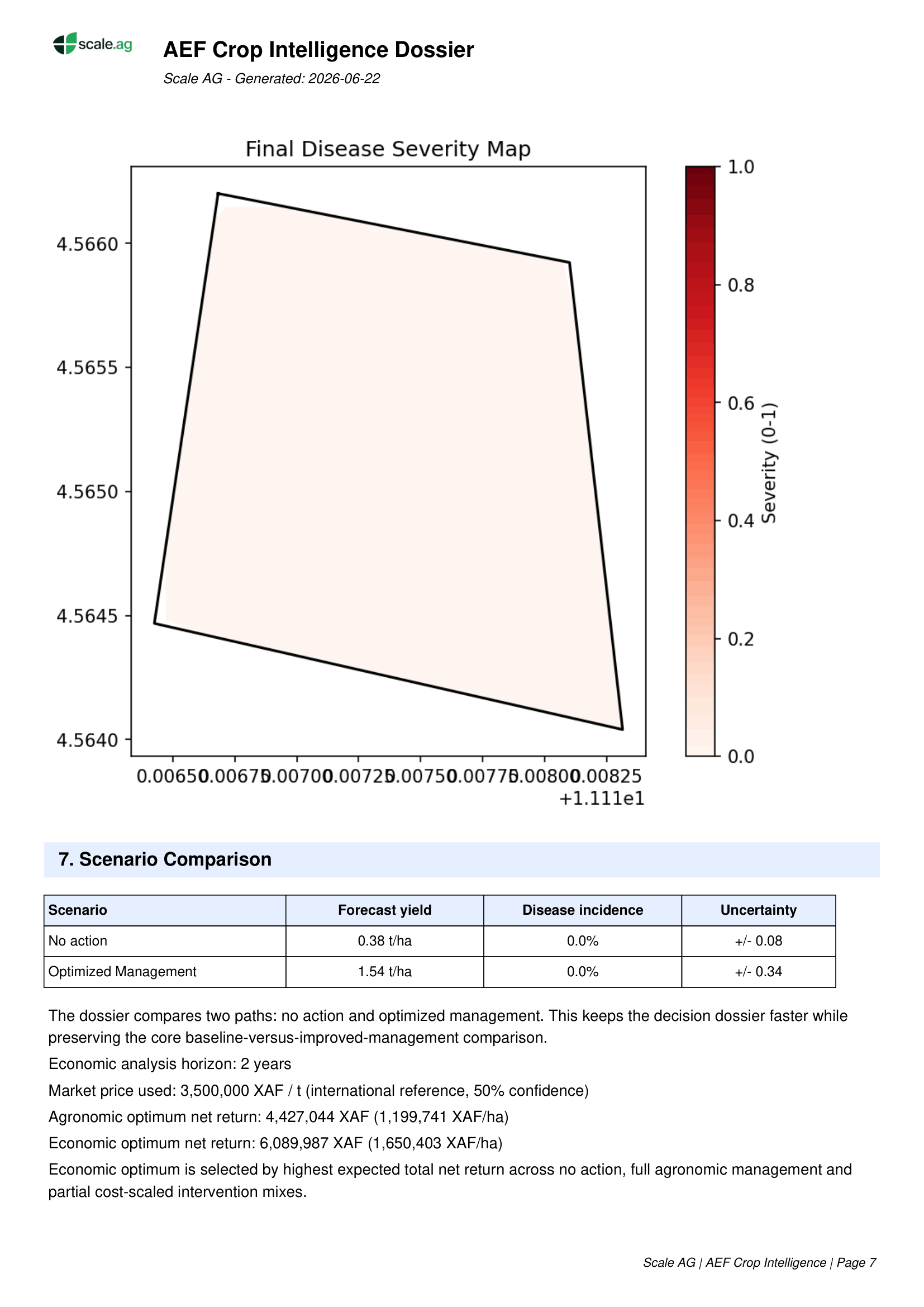
Generated final report - page 7
PDF 7/9

Generated final report - page 7

Extract from the final dossier generated by AEF Crop Intelligence for the cocoa case presented.

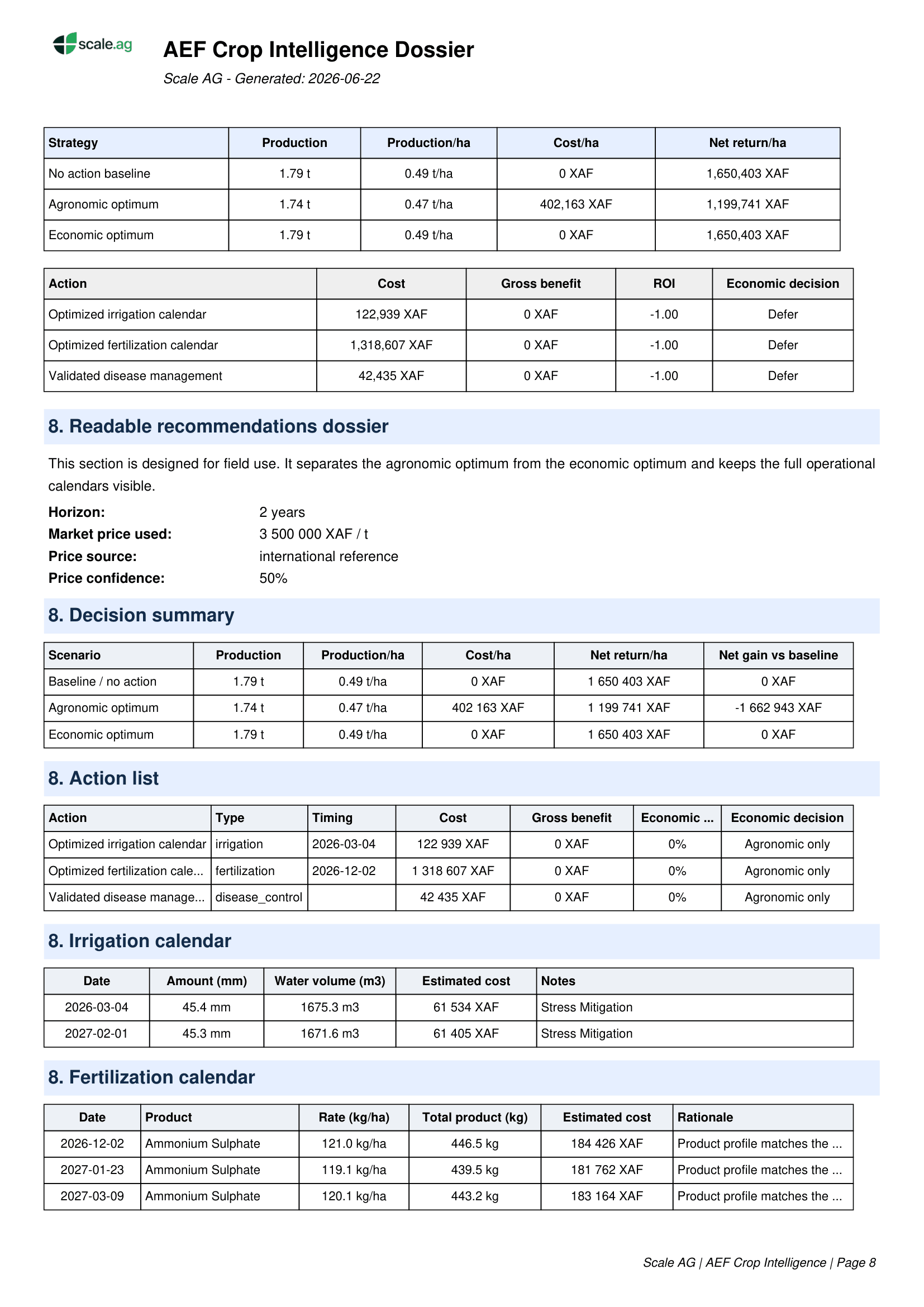
Generated final report - page 8
PDF 8/9

Generated final report - page 8

Extract from the final dossier generated by AEF Crop Intelligence for the cocoa case presented.

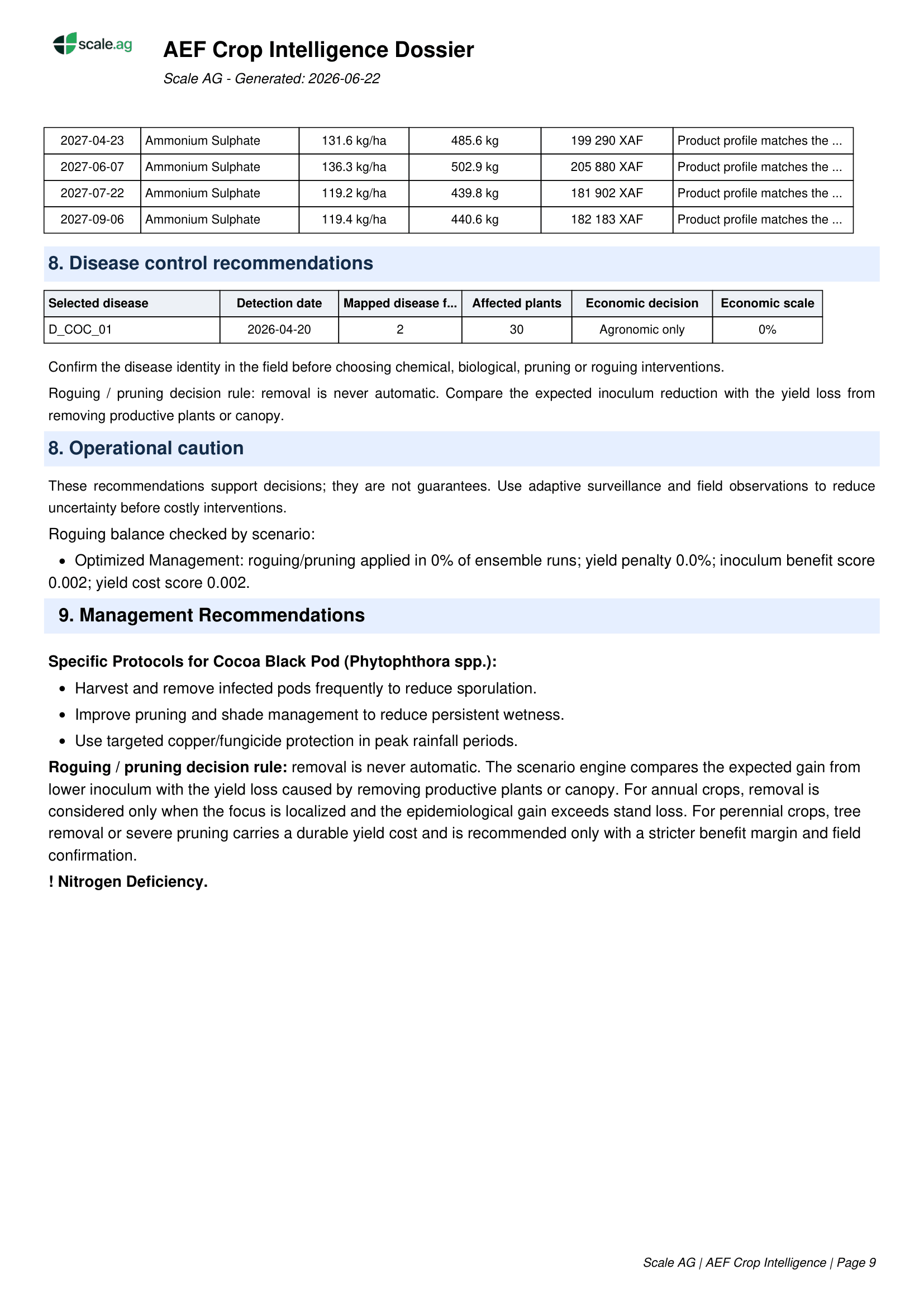
Generated final report - page 9
PDF 9/9

Generated final report - page 9

Extract from the final dossier generated by AEF Crop Intelligence for the cocoa case presented.

What AEF Crop Intelligence covers

BlockFunction
GeographyCoordinates, satellite map, smart boundary, non-overlapping cooperative plots, large non-cultivated gaps accepted.
AgronomyCrop, variety, cycle, perennial crops, soil, nutrients, water stress and nutrient stress.
DiseaseCautious satellite detection, manual foci, stochastic models, roguing/pruning with inoculum versus yield trade-off.
EconomicsPrices, costs, labour, irrigation, fertilization, disease control, economic optimum and what-if scenarios.
OutputsDashboard, recommendations, recommendation PDF, final PDF, JSON, adaptive surveillance and calibration.
Accepted limit. AEF remains a decision-support tool. Forecasts must be reviewed with field observations, real prices, local constraints and pilot validation.